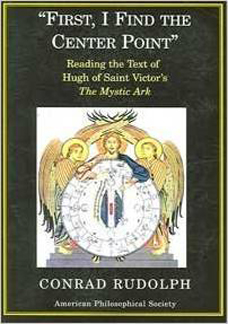
 2005, American Philosophical Society
For an abstract, go to the following link and search the page:
https://ucriverside.academia.edu/ConradRudolph

2005, American Philosophical Society
For an abstract, go to the following link and search the page:
https://ucriverside.academia.edu/ConradRudolph
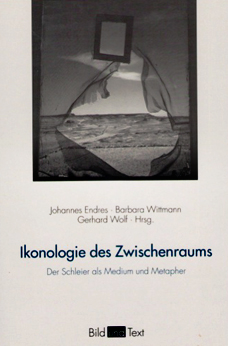 Iconology of Interspace: The Veil as Medium and Metaphor
2005, FINK: MUNICH
This volume gathers the proceedings of the conference “Veil: Image, Text, Ritual”, co-organized with Gerhard Wolf at the University of Trier in 2001. Its contributions discuss the veil as an artistic motif, a literary metaphor and an episteme in aesthetics, ethnology, anthropology, philosophy, social and political sciences. Both conference and book brought together specialist from various fields to explore the changes and continuities of representations of the veil. The contributions are tied together by conceptual essays from the editors, which highlight overarching aspects such as textures of opacity, allegories of seeing and reading, thresholds between media, and specters and their garments‹. Conference and book realize a fruitful collaboration between academics from literary history, art history, philosophy, and beyond.
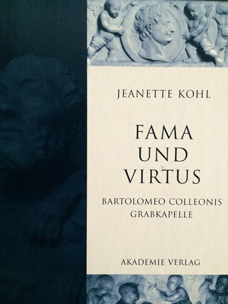
Fama und Virtus: Bartolomeo Colleonis Grabkapelle.
2004, Akademie Verlag GmbH
“In sum, this is by far the most useful study of the Colleoni Chapel and the most thorough, insightful study ever done on the iconography of a Lombard Renaissance sculptural monument.” Charles Morscheck in: Journal of the Society of Architectural Historians JSAH, 67/2, June 2008
“Die Kunsthistorikerin Jeanette Kohl hat der Grabkapelle Colleonis nun ein wunderbar kluges Buch gewidmet, in dem sie das Denken dieses Soldnerführers im Spannungsfeld von fama und virtus anhand des Bildprogramms erläutert.” (“The art historian Jeanette Kohl has dedicated a wonderfully erudite book on the chapel of Colleoni, in which she unfolds the mercenary’s representational thinking between the poles of fame and virtue through the chapel’s image program.”) Michael Thimann in: Süddeutsche Zeitung, February 22, 2005
“Die Stärke der Arbeit liegt in der ikonographischen Analyse der Fassaden- und Grabmalsskulptur, deren kontextgebundene Bedeutung die Autorin souverän und kritisch zur Diskussion stellt.” (“The book’s strength lies in its icongraphic analysis of the sculptural program on façade and tomb, whose context and meaning the author discusses both masterfully and with a critical eye.”) Antje Fehrmann in: Journal fur Kunstgeschichte, 2/2007
 Pilgrimage to the End of the World: The Road to Santiago de Compostela (Culture Trails: Adventure in Travel)
2004, University of Chicago Press
For an abstract, go to the following link and search the page:
https://ucriverside.academia.edu/ConradRudolph
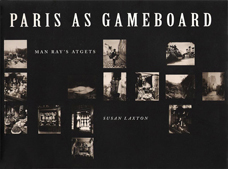 Paris As Gameboard: Man Ray’s Atgets
2002, Ex. cat. New York: The Wallach Gallery
Soon after moving to France, Man Ray began collecting the works of his forebear Eugene Atget, whose pictures surveyed Paris in the late 19th and early 20th century. Here, for the first time, these images of the urban landscape are considered through a Surrealist frame collectively, as a peripatetic surrealist text comparable to André Breton’s Nadja and Louis Aragon’s Paris Peasant.
Re-Visionen: Zur Aktualität von Kunstgeschichte
2002, Akademie-Verlag
“This book is an homage to Swiss art historian Alexander Perrig, whose incorruptible eye and unconventional thinking inspired 15 case studies, written for this book. They all revise established interpretations, with Perrig’s work in mind, from the façade of the Trier Cathedral to scientific illustrations of the 17th century to the Latin Lover in the era of silent films. With essays by Wolfgang Kemp, Hans Joachim Kunst, Norberto Gramaccini, Jeanette Kohl, Roberto Zapperi, Jochen Staebel, Christina Riebesell, Horst Bredekamp, Barbara und Richard Huettel, Ursula Harter, Monika Wagner, Peter Rautmann, Renate Berger, Joerg Jochen Berns, Werner Hofmann, and an introduction by Leo Steinberg.“
Review by Michael Thimann, Sueddeutsche Zeitung