
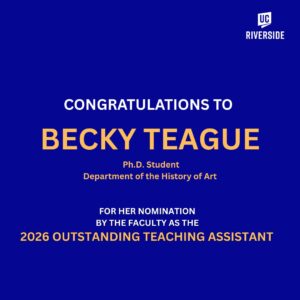
 Congratuations to Becky Teague!
It is a distinct pleasure to announce that department faculty have nominated Rebecca Teague as this year’s outstanding Art History TA. Professors lauded Becky for her commitment to enhancing the education experiences of students in her sections. She is approaches the position with an enviable combination of enthusiasm, knowledge, poise, and organization. What’s more, Becky demonstrates an ongoing commitment to developing her teaching practices. Congratulations, Becky!
As always, there were many outstanding candidates. In this vein, the faculty identified Angelica Parr-Rosser as our runner up nominee. Most importantly, we recognize the dedication, work, and talent of each and every TA during the past year. Art History is known for offering great lower division courses, and TAs are a vital component of that!
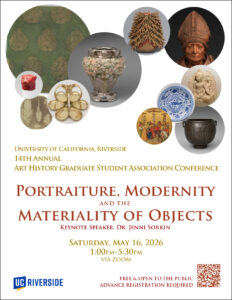 The University of California, Riverside’s Art History Graduate Student Association is pleased to announce its 14th Annual Conference, Portraiture, Modernity, and the Materiality of Objects.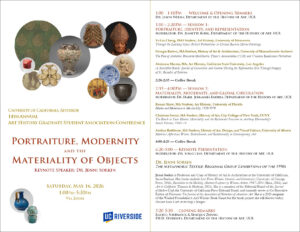

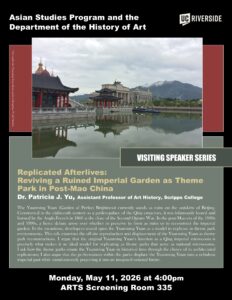 The Yuanming Yuan (Garden of Perfect Brightness) currently stands as ruins on the outskirts of Beijing. Constructed in the eighteenth century as a garden-palace of the Qing emperors, it was infamously looted and burned by the Anglo-French in 1860 at the close of the Second Opium War. In the post-Mao era of the 1980s and 1990s, a fierce debate arose over whether to preserve its form as ruins or to reconstruct the imperial garden. In the meantime, developers seized upon the Yuanming Yuan as a model to replicate in theme park environments. This talk examines the off-site reproduction and displacement of the Yuanming Yuan as theme park reconstructions. I argue that the original Yuanming Yuan’s function as a Qing imperial microcosm is precisely what makes it an ideal model for replicating as theme parks that serve as national microcosms. I ask how the theme parks situate the Yuanming Yuan in historical time through the choice of its architectural replications; I also argue that the performances within the parks displace the Yuanming Yuan into a nebulous imperial past while simultaneously projecting it into an imagined national future.
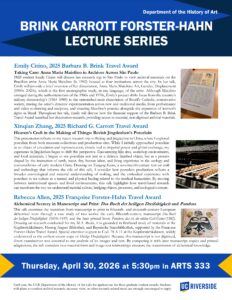 Emily Citino, 2025 Barbara B. Brink Travel Award
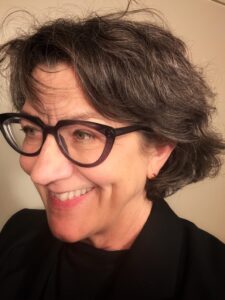 Demonstrating a loud and clear commitment to advancing its world-class research enterprise, the University of California, Riverside (UCR) announces that Susan Laxton, Associate Professor of Modernism and the History of Photography and Chair of the Department of the History of Art, has been selected for the esteemed
 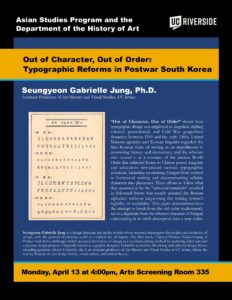 “Out of Character, Out of Order” shows how typographic design was employed to negotiate shifting colonial, postcolonial, and Cold War geopolitical dynamics between 1945 and the early 1960s. United Nations agencies and Korean linguists regarded the Sino-Korean form of writing as an impediment to promoting literacy and democracy; and the scholars also viewed it as a remnant of the ancient World Order that subjected Korea to Chinese power. Linguists and educators introduced various typographic solutions, including reorienting Hangeul from vertical to horizontal writing and deconstructing syllabic characters into phonemes. These efforts to follow what they assumed to be the “universal standards” resulted in deformed letters that merely imitated the Roman alphabet without improving the writing system’s legibility or readability. This paper demonstrates how the attempt to break from the old order inadvertently led to a departure from the inherent character of Hangeul, culminating in its swift absorption into a new order.