Portraiture, Modernity, and the Materiality of Objects
14th Annual Art History Graduate Student Association Conference, University of California, Riverside | May 16, 2026 from 1:00-5:30 PM | Via Zoom
Keynote Speaker: Dr. Jenni Sorkin, Professor and Chair, History of Art & Architecture, University of California, Santa Barbara
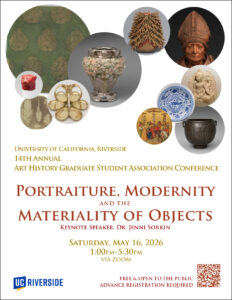 The University of California, Riverside’s Art History Graduate Student Association is pleased to announce its 14th Annual Conference, Portraiture, Modernity, and the Materiality of Objects.
The distant jadeite stone–its cool blue-green echoing young maize–was carved in the Olmec world into the sacred form of the Kunz Axe. Cobalt carried along Mongol-era trade routes met Jingdezhen’s kaolin clay and, through kiln fired, produced blue-and-white porcelain. In Roman art, materials such as marble, bronze, and pigment shaped movement, light, and the sensory experience of power. Across cultures and histories, materials have shaped not only objects, but the conditions of making, meaning, and use.
This conference invites graduate students to examine portraiture, modernity, and materiality as active forces rather than a passive surface. Matter speaks: their voice awakening the impulse to make. Objects are encountered through the body and the senses: handled, worn, repaired, and transformed over time. Drawing on approaches including phenomenology, material culture studies, and new materialisms, we ask how materials carry memory, structure experience, and demand particular modes of making, care, and interpretation.
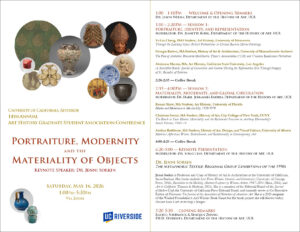
The conference will be held on Zoom on Saturday, May 16, 2026.
The conference is free and open to the public.

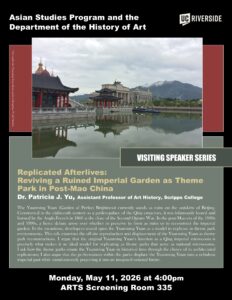 The Yuanming Yuan (Garden of Perfect Brightness) currently stands as ruins on the outskirts of Beijing. Constructed in the eighteenth century as a garden-palace of the Qing emperors, it was infamously looted and burned by the Anglo-French in 1860 at the close of the Second Opium War. In the post-Mao era of the 1980s and 1990s, a fierce debate arose over whether to preserve its form as ruins or to reconstruct the imperial garden. In the meantime, developers seized upon the Yuanming Yuan as a model to replicate in theme park environments. This talk examines the off-site reproduction and displacement of the Yuanming Yuan as theme park reconstructions. I argue that the original Yuanming Yuan’s function as a Qing imperial microcosm is precisely what makes it an ideal model for replicating as theme parks that serve as national microcosms. I ask how the theme parks situate the Yuanming Yuan in historical time through the choice of its architectural replications; I also argue that the performances within the parks displace the Yuanming Yuan into a nebulous imperial past while simultaneously projecting it into an imagined national future.
 Eadweard Muybridge’s innovations in photographic and moving-image cultures were immensely influential across the final decades of the nineteenth century, then for twentieth century artists such as Francis Bacon and Marcel Duchamp, and remain provocative and inspirational for contemporary artists, filmmakers, choreographers and digital-media creators. He travelled relentlessly from his arrival in the USA in 1850 at the age of twenty until his return to the UK in 1894, accumulating a vast itinerant archive of his work which he devoted his final decade to distilling into the form of an immense, multi-layered scrapbook intended for future researchers. Alongside his photographing with multiple cameras of human and animal movement, Muybridge undertook international tours with his ‘Zoopraxiscope’ projector, astonishing audiences of artists and scientists in every city in which he appeared. He was also a self-confessed (but exonerated) murderer. Based on extensive research into Muybridge’s little-known personal archive, this talk will examine three aspects of the work of this legendary figure: his experimentations with representing urban space, especially in the form of street-photography and San Francisco panoramas; his obsessive accumulation of his archive; and his moving-image public projections in Europe and at his own self-designed auditorium at the Chicago World’s Columbian Exposition, in the years immediately before the origins of cinema.
 The verdant Kashmir Valley, a place of unearthly beauty, has long been a subject of praise and description. The history and geography of Kashmir appeared in multiple literary genres, including Sanskrit sources which claimed the valley to be a sacred landscape and Persian courtly literature which characterised Kashmir as being jannat nazir (paradise like). Recent scholarship has highlighted the connections between Mughal literary imaginings, political discourse, and the construction of gardens in Kashmir, interpreting these landscaped spaces as a means to claim sovereignty over the land. In the nineteenth century, the region was again the subject of an imperial discourse, that of the British empire, a discourse shaped by a particular interest in the production of Kashmiri shawls, a highly sought after commodity in Victorian England. Among the shawls were a small set of embroidered ‘map’ shawls which depicted the city of Srinagar and its significant landmarks, both natural and manmade, one of which was sent as a gift to Queen Victoria. Large-scale painted cotton maps of the entire valley were also produced in the mid-nineteenth century, often employing the same visual conventions as the shawls. This paper explores the image-making practices which underlay the production of these textiles, departing from existing scholarship which has emphasized their imbrication within the colonial enterprise. I instead approach their resistance of the colonial gaze and highlight how the craftsmen creating them were informed by a distinctly South Asian, perhaps even Kashmiri, sense of place.
  The lecture is dedicated to an attempt at a “phenomenology” of female bust portraits of the Quattrocento. The focus is on the enigmatic bust of an unknown woman by Francesco Laurana in the Viennese Kunstkammer, which is characterized by its unusual polychrome. In the context of a comparative object analysis and against the cultural-historical background of a Petrarchan topic, the question of how this and other female busts ‘communicate’ with the viewer and what significance their fragmentary object character has will be pursued. Although not primarily motivated by the art-historical “passion for identifying” (Didi-Huberman), the considerations ultimately lead to a proposed new identification.