Huntington Library Open House @UCR
Wednesday, October 1, 2025 3pm to 5:30pm

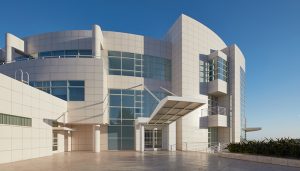
The Huntington Comes to UCR!

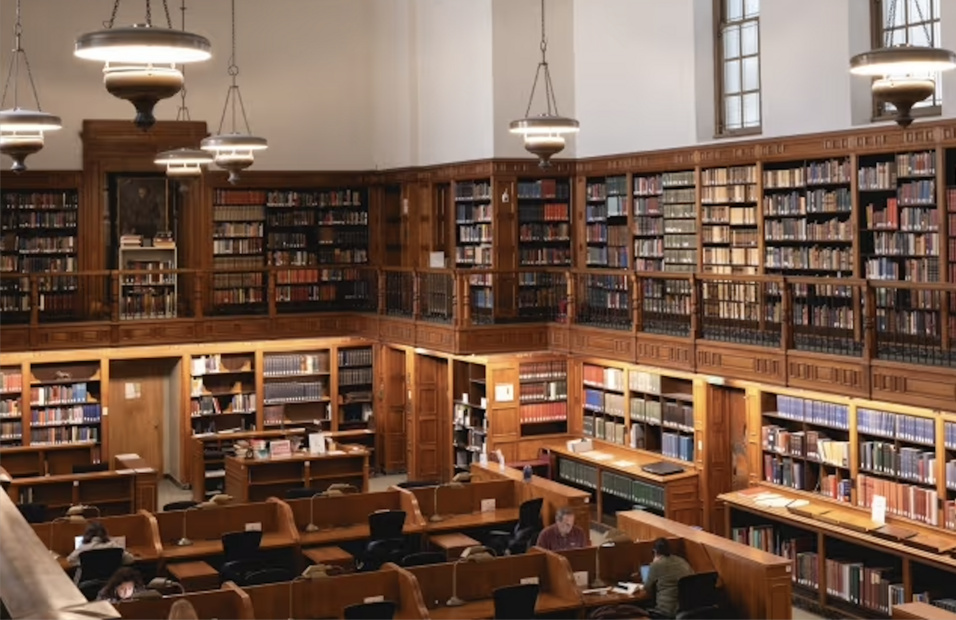
Join Huntington Library Director of Research Susan Juster, members of her staff, and Huntington curators for an Open House event at UC Riverside. Juster and her team will share insights into the Huntington’s fellowship program, the application process, and what makes for a strong application.

The Huntington is a word-class research institution, which promotes humanities scholarship on the basis of its library holdings and art collections. 

Whether you are a graduate student or a faculty member, please mark your calendar. This is a unique opportunity to learn and connect. An informal reception with drinks and snacks will follow the presentations.

Schedule

3:00-4:30 – Presentations from Huntington programming team, with Q&A
4:30-5:30 – Reception

RSVPs appreciated: https://bit.ly/HuntingtonUCR

Speakers

Susan Juster oversees the Research division that hosts more than 150 long- and short-term research fellows each year, selected through a competitive, peer-review process that provides $1.4 million in awards.

Brett Rushforth is editor-in-chief of the Huntington Library Quarterly, a peer-reviewed academic journal featuring original research and new perspectives on early modern art, literature, history, science, medicine, and material culture.

Shannon McHugh, the assistant director of research, helps connect the research of Huntington fellows with broader audiences while making connections between The Huntington’s historical collections and the present.

Vanessa Wilkie, Ph.D., is the head of the Library Curatorial department and curates the Library’s renowned collections of medieval manuscripts and British history.

Diva Zumaya, Ph.D., the associate curator of European art, researches The Huntington’s collection of European art, finds new connections between objects, and collaborates with Library and Botanical colleagues.

Sponsored by the UCR Department of History and the Being Human initiative at the Center for Ideas and Society.


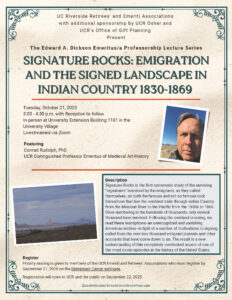
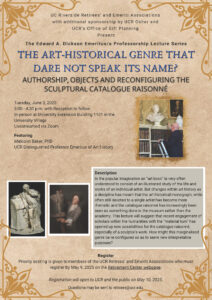
UC Riverside Retirees’ and Emeriti Associations with additional sponsorship by UCR Osher and UCR’s Office of Gift Planning Present
The Edward A. Dickson Emeritus/a Professorship Lecture Series


Dickson Flyer Malcolm BakerMalcolm Baker, Distinguished Professor Emeritus of Art History
THE ART-HISTORICAL GENRE THAT DARE NOT SPEAK ITS NAME?  Authorship, Objects and Reconfiguring the Sculptural Catalogue Raisonné

Tuesday, June 3, 2025
3:00 – 4:30 p.m. with Reception to follow
In-person at University Extension Building 1101 in the University Village
Livestreamed via Zoom

https://events.ucr.edu/event/the-art-historical-genre-that-dare-not-speak-its-name-authorship-objects-and-reconfiguring-the-sculptural-catalogue-raisonne

2025 Brink Carrott Forster-Hahn Lecture Series

Join Us on Wednesday, May 28, 2025 at 5:30pm in ARTS 333

Brink Carrott Forester-Hahn Lecture SeriesSarah Salisbury, 2024 Barbara B. Brink Travel Award
Monumental Meetings: Locating Indigenous Monumentality at the Four Corners
Since 1875, the Four Corners Monument sits isolated at the northeast corner of the sovereign Navajo Nation, where it marks the convergence of four U.S. states — Arizona, Utah, Colorado, and New Mexico. Over the past hundred fifty years, the monument has increasingly become a popular tourist destination, though it appears solely to celebrate its colonial cartography. In 2010, however, something unique happened. The Navajo Nation and the Ute Mountain Tribe, with assistance from various federal agencies, completed a total redesign of the monument. Its newly enlarged complex now situates a medley of forms that inscribe Indigenous values to the cadastral landmark. Therefore, it now appears the monument convenes two systems of culture — Indigenous American and Western-US settler-colonial — altering the commemorative significance of the Four Corners Monument.

Elizabeth Carleton, 2024 Richard G. Carrott Travel Award
Perfecting Galileo: Collaborations Between Artist and Astronomer in 17th-Century Europe
My dissertation evaluates three responses to Galileo’s lunar representations: Claude Mellan’s 1637 lunar engravings; Johannes Hevelius’s 1647 lunar atlas, Selenographia: sive, lunae descriptio; and Giovanni Battista Riccioli’s 1651 Almagestum novum. Each of these projects represents a different type of collaboration between artist and scientist in the early modern period. In revisiting seventeenth-century selenography, I hope to enhance our understanding of the intellectual landscape of early modern Europe. The Carrott Grant enabled me to travel to Paris to conduct primary source research at the Bibliothèque nationale de France and the Paris Observatory.

Homer Arnold, 2024 Françoise Forster-Hahn Travel Award
Enabling the Enablers: Carp and the NEA
This talk examines how the Los Angeles arts production team Carp utilized loopholes and new grant categories created by the N.E.A. to fund their exhibitions during the long 1970s. While there is a canonized history of the “dematerialized” art object, there is a lesser-studied history of those who empowered artists in these pursuits, and an even lesser-known history of the funding that enabled this vaporization. Carp is a prime example of these understudied areas. To assist artists in the creation of public, ephemeral, and peripatetic artworks, Carp needed to stand at the complex intersection of art, the public, and money. As they succeeded in their fundraising, their projects became successful confrontations to pressing social issues while maintaining the DIY spirit of that decade. However, their success still depended on funding, showing that art in that era was tied to government and economic policies, even though artists often claimed otherwise.


Vera Molnar’s Drawing Machines: A Media Archaeology of Early Computer Graphics

Zsofi Valyi-Nagy, Ph.D Visiting Assistant Professor in Art History at Scripps College
Wednesday, May 14 at 5:30pm, INTS 1128

How do you draw a line with a computer? When the Hungarian-born, Paris-based artist Vera Molnar (1924-2023) began exper-imenting with electronic computers in 1968, this task was not as simple as the click of a mouse or the swipe of a finger. Molnar had to translate her visual language of geometric abstraction into alphanumeric instructions that a computer would understand. Though she generated thousands of computer plotter “drawings” over the next two decades, she left behind limited technical documentation from this period, leaving it up to viewers to imagine the algorithms behind her compositions. This lecture presents a media archeology of the artist’s work –– a hands-on approach that engages not only with her drawings but also her process of drawing with a computer. I will recount my “reenactment” of Molnar’s series Lettres de ma mère (My mother’s letters, 1988) using obsolete hardware and software that the artist once used. This practice-led approach foregrounds the artist’s process and historically contextualizes the material history and user experience of early interactive computing, which have been all but forgotten.


Book Talk: Leaving Legacies and the Making of Early Modern South Asia

Book Talk: Leaving Legacies and the Making of Early Modern South Asia

Shayan Rajani, Ph.D., Assistant Professor of History, Michigan State University
Monday, May 5 at 4:00pm, CHASS INTS 1111

Shayan Rajani is an Assistant Professor of History at Michigan State University. He is the author of Leaving Legacies: The Individual in Early Modern South Asia published by Cambridge University Press in 2024. His research interests include early modern South Asia, particularly the region of Sindh, the history of the individual and self-representation, and gender and sexuality.

Co-Sponsored by the Department of History, the Asian Studies Program, and the Middle East and Islamic Studies Program.


Yong Soon Min: Reimagining the Inheritances of Empire

Kylie Ching Talk, April 17, 2025

Kylie Ching, Ph.D.
UCR Chancellor’s Postdoctoral Fellow

How does one remember an unending war? Within U.S. history, the Korean War remains the “forgotten war,” overshadowed by World War II and the Vietnam War. For the late artist, activist, and educator Yong Soon Min, this contradiction makes the Korean War an important site to parse through its history and meaning. Rather than focusing on scenes of spectacular militarized violence, she draws attention to how the civil war continues to shape everyday life in Korea and its diaspora. Centering personal and embodied experiences as a form of history, Min repurposes photographs across family and state archives to reimagine alternative kinships that disrupt U.S. Cold War historiographies. This talk will explore two works — a photomontage called Talking Herstory from 1990 and a multi-media installation entitled Mother Load from 1996 that was later remade in 2014. Within these works, Min reveals the visible and invisible inheritances of war, such as memories, physical objects like photographs and clothes, and family relations.

PLEASE NOTE: THIS TALK HAS BEEN RESCHEDUED FOR APRIL 17

In-person
Thursday, April, 17, 2025 at 5:00pm
CHASS Interdisciplinary South, 1111