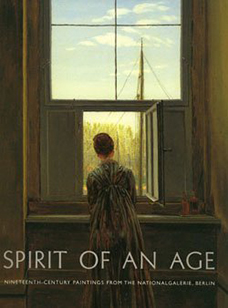
SpiritofanAge

Spirit of an Age: Nineteenth-Century Paintings From the National Galerie, Berlin
2001, National Gallery Company
Françoise Forster-Hahn, et al

Exhibition catalog. Contributions by Françoise Froster-Hahn, Claude Keisch, Peter-Klaus Schuster, Angelika Wesenberg, Christopher Riopelle and Birgit Verwiebe. Examined artists incllude Caspar David Friedrich, Carl Blechen, Adolph Menzel, Wilhelm Beibi, Anselm Feuerbach, Carl Schuch Max Liebermann, etc. Comparisions to 19th century french paintings too. Bibliography. Index. 192pp.
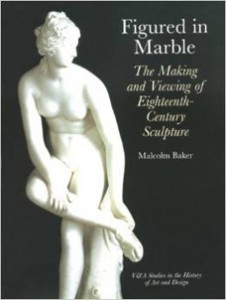
FiguredinMarbleFigured in Marble: the Making and Viewing of Eighteenth-Century Sculpture
2001, London and Los Angeles: V&A Publications and J.Paul Getty Museum (shortlisted for Apollo Book of the Year 2001)
Malcolm Baker, author

This work is a study of 18th-century British sculpture, illustrated with sculptures from both the V&A and the J. Paul Getty Museum and also many impressive pieces from private collections and churches. The book starts suggesting new ways of looking at 18th-century sculpture and exploring its relationship to themes that have figured prominently in recent discussions on British painting. The relationship between painting and sculpture, and the links between making and viewing, are themes that are explored throughout the book. The chapters are arranged in five sections, each prefaced by a brief introduction, forming groups of case studies which illustrate approaches to: writing sculptural histories; design, making and materials; categories and genres; and finally, settings, collecting and display.

Read More →

Das depotenzierte subjektThe “Disempowered” Subject: On the History and Function of Comedy in Heinrich von Kleist’s Works
1996, Königshausen & Neumann: WÜRZBURG
Johannes Endres, author

Kleist scholars tend to imagine the author as the paradigmatic exponent of a tragic mind. The shadows of his tragedies in life and literature seem too heavy and gloomy to leave room for comic tendencies. Although Kleist’s two comedies have always been acknowledged as true highlights in the history of the genre, his comic “strategies” – as well as their precedents from Lessing to Freud – have mostly been ignored. However, with such strategies in mind, the author’s situation appears as one in which the demands of an idealist worldview provoke a retreat to the limited and reduced formats of comedy. Kleist’s massive ›struggle with Schiller‹ – his predominant role model and antipode – is here reexamined in the light of a general struggle to avoid tragic inevitabilities.