Art History Doctoral Candidate, Cambra Sklarz, presented at the Getty Graduate Symposium on February 3, 2023
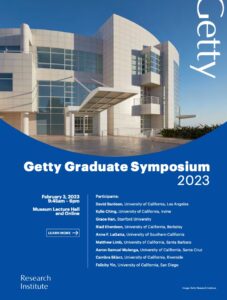
etty Graduate Symposium2023The Getty Research Institute hosted the fifth annual Getty Graduate Symposium, which showcased the work of emerging scholars from art history graduate programs across California. Organized into three sessions, the symposium included nine individual presentations, panel discussions moderated by faculty mentors, and Q&A sessions with the audience. 

Congratulations to Cambra Sklarz for being recognized for her outstanding work.

Cambra’s presentations, The Artist and the Ecosystem: Strategies for the Use and Reuse of Materials in Early America can be viewed online via the Getty Research Institute’s YouTube channel: https://www.youtube.com/playlist?list=PLdcw4RhcVX8s4hcliEh_DUburxDcBvo6Q

The full program can be found here.
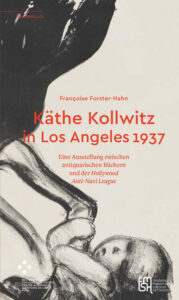


Käthe Kollwitz in Los Angeles 1937 Eine Ausstellung zwischen antiquarischen Büchern und der Hollywood Anti-Nazi LeagueKäthe Kollwitz in Los Angeles 1937: Eine Ausstellung zwischen antiquarischen Büchern und der Hollywood Anti-Nazi League
2022, DEUTSCH FORUM FÜR KUNSTGESCHICHTE, DFK PARIS
Françoise Forster-Hahn, author

In June 1937, Jacob Zeitlin opened an exhibition of graphics by Käthe Kollwitz in his bookstore gallery in Los Angeles. It was the first exhibition of Kollwitz’s work in Southern California. The exhibition and the glamorous vernissage were co-sponsored by the Hollywood Anti-Nazi League for the Defense of American Democracy. The evening’s speakers were German writer and activist Ernst Toller and American composer George Antheil. Among the illustrious guests were Fritz Lang, Richard Neutra, Arnold Schönberg, George Gershwin, Kurt Weill and other celebrities from the film industry and the German-Austrian exile community. The Kollwitz exhibition became the focal point of the city’s central areas of conflict: it was not just a cultural event in Zeitlin’s bookstore gallery, but above all a targeted political action by the Hollywood Anti-Nazi League. Kollwitz’s work was thus caught in the crossfire of the conflict between the anti-fascist struggle of the Anti-Nazi League and the violent actions of National Socialist groups in Los Angeles. In this political tension, Käthe Kollwitz was perceived as an “anti-Nazi artist” and her exhibition was ascribed an active role in the fight against Hitler. The chapters of the book trace how the exhibition became the crossroads of four biographies: Käthe Kollwitz, Jacob Zeitlin, Ernst Toller and George Antheil.

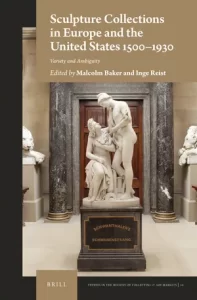
Sculpture Collections in Europe and the United States, 1500-1930
2021, Brill, in association with The Frick Collection
Malcolm Baker, co-editor

Exploring the variety of forms taken by collections of sculpture, this volume presents new research by twelve internationally recognized scholars. The essays delve into the motivations of different collectors, the modes of display, and the aesthetics of viewing sculpture, bringing to light much new archival material. The book underscores the ambiguous nature of sculpture collections, variously understood as decorative components of interiors or gardens, as objects of desire in cabinets of curiosity, or as autonomous works of art in private and public collections. Emphasizing the collections and the ways in which these were viewed and described, this book addresses a significant but neglected aspect of art collecting and contributes to the literature on this branch of art and cultural history.

This book evolved from a symposium “Sculpture Collecting and Display, 1600-2000,” organized by the Center for the History of Collecting, that was held at The Frick Collection on May 19 and 20, 2017. Both the book and the symposium were made possible through the generous support of the Robert H. Smith Family Foundation.

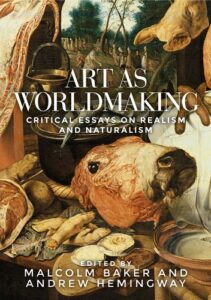
Art as WorldmakingArt as Worldmaking: Critical Essays on Realism and Naturalism
2018, Manchester University Press
Malcolm Baker, co-editor

Art as Worldmaking is a response to Alex Potts’s provocative 2013 book Experiments in modern realism. Twenty essays by leading scholars test Potts’s recasting of realism through examinations of art produced in different media and periods, ranging from eighth-century Chinese garden aesthetics to video work by the contemporary Russian collective Radek Community. While the book does not neglect avatars of pictorial realism such as Menzel and Eakins, or the question of nineteenth-century realism’s historical antecedents, it is contemporary in orientation in that many contributors are particularly concerned with the questions that sculpture, photography and non-traditional media pose for realism as an aesthetic norm. It will be essential reading for students of art history concerned with art’s truth value or more broadly with conceptual problems of representation and the intersections of art and politics.