
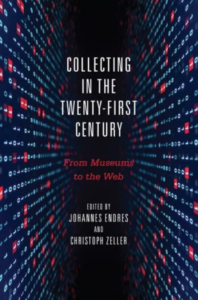
 From Museums to the Internet: Collecting in the Twenty-First Century
Seminal to the rise of human cultures, the practice of collecting is an expression of individual and societal self-understanding. Through collections, cultures learn and grow. The introduction of digital technology has accelerated this process and at the same time changed how, what, and whywe collect. Ever-expanding storage capacities and the accumulation of unprecedented amounts of data are part of a highly complex information economy in which collecting has become even more important for the formation of the past, present, and future. Museums, libraries, and archives have adapted to the requirements of a digital environment, as has anyone who browses the internet and stores information on hard drives or cloud servers. In turn, companies follow the digital footprint we leave behind. Today, collecting includes not only physical objects but also the binary code that allows for their virtual representation on screen. Collecting in the Twenty-First Centuryidentifies the impact of technology, both new and old, on the cultural practice of collecting as well as the challenges and opportunities of collecting in the digital era. Scholars from German Studies, Media Studies, Museum Studies, Sound Studies, Information Technology, and Art History as well as librarians and preservationists offer insights into the most recent developments in collecting practices.
 Demystifying Graduate School in Art History
 The lecture is dedicated to an attempt at a “phenomenology” of female bust portraits of the Quattrocento. The focus is on the enigmatic bust of an unknown woman by Francesco Laurana in the Viennese Kunstkammer, which is characterized by its unusual polychrome. In the context of a comparative object analysis and against the cultural-historical background of a Petrarchan topic, the question of how this and other female busts ‘communicate’ with the viewer and what significance their fragmentary object character has will be pursued. Although not primarily motivated by the art-historical “passion for identifying” (Didi-Huberman), the considerations ultimately lead to a proposed new identification.
 At Durham, Professor Endres will work on his current book project on “Style” as an interdisciplinary category of the study of texts, images and music. As part of his project, he will be in close collaboration with Professor Jonathan Long from Durham’s School of Modern Languages & Cultures. Professor Long is also the co-director of the Center for Visual Arts and Culture at Durham. The collaboration is based on their mutual research interest in German Literature, literary theory, and the study of visual culture in relation to literary artefacts.