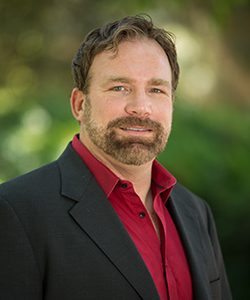
Jason Weems Awarded Fulbright Fellowship

UCR Anthropologist and Art Historian Awarded Fulbright Fellowships
Yolanda Moses will study new model of inclusiveness in Australia; Jason Weems will explore the intertwining of art and archaeology in the Americas
UCR Today
by on June 2, 2016

WeemsBig“Jason Weems, associate professor of art history, will pursue research at the Instituto Franklin of the Universidad de Alcala in Madrid, Spain, to develop an intellectual and historical framework for understanding American art through the lens of the Americas.

Weems, who joined the UC Riverside faculty in 2008, will spend the winter and spring quarters of 2016-17 conducting research and teaching at The University of Alcala’s Franklin Institute in a project that he hopes will foster a more globalized approach to American art history both at home and abroad. Research conducted in colonial archives and at various art museums also will support a book-length project, “Inventing the Americas: Art, Archaeology and the Modern Making of a Pre-Columbian Past.”

“While American art has traditionally been understood as the study of ‘art of the United States,’ recently efforts have begun to understand the deep entanglement of national art within a more expansive network of indigenous, cross-cultural and international exchange,” he explained. “One result of this shift has been the expansion of American art to encompass the many places and peoples, across both the Western hemisphere and the globe, which played formative roles in the synthesis of American artistic and representational practices. This more diversified appreciation is often referred to as the ‘arts of the Americas.’”

Refocusing American art scholarship away from narratives of European colonial domination toward a more balanced approach to the Americas offers new and better opportunities to understand the rich cultural networks that shape the history and future of the hemisphere and the place of artistic expression within it, Weems said.”
Read more…

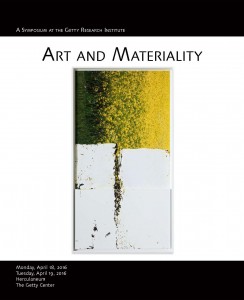
Art and Materiality at The Getty Center

ABOUT THE SYMPOSIUM
In the past decade, the increased attention to the art object and its materiality has enhanced the study of art history, opening new avenues of investigation. Combined with more historical methodologies, the focus on materiality offers profound insights into the artworks’ meanings. Artists across space and time have infused materials with not only ritual and symbolic significance but also social, political, and economic functions. Art historians, increasingly in collaboration with conservators and scientists, are gaining insight into both the process of art-making, from raw material to finished object (the chaîne opératoire), and the strategic deployment of materials for their aesthetic qualities and their power to signify.
This two-day symposium will investigate the materiality of artworks and raise questions about procurement, trade, value, manufacturing, and the accumulation of new meanings as objects move between cultures.

UCR Faculty members, Jeanette Kohl and Malcolm Baker will present on Monday, April 18:

Monday, April 18 at 11:25 am:
Making, Replication, and the Eighteenth-Century Portrait Bust: Digitizing and Interpreting Roubiliac’s Busts of Alexander Pope
Malcolm Baker, University of California, Riverside, and Chelsea Alene Graham, Yale University

Monday, April 18 at 1:45pm:
Tracing Presence: The Portrait Bust between Materiality and “Phenomenology”
Jeanette Kohl, University of California, Riverside

Click here to view the full two-day program

RECEPTIONS
A reception will be held at the close of each day:
April 18th, 5:45 p.m., Lounge Patio, Luxe Sunset Boulevard Hotel
April 19th, 6:00 p.m., Private Dining Room, Getty Center

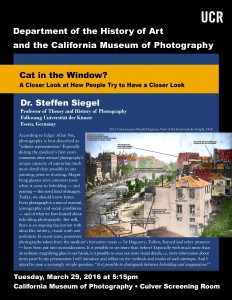
Dr. Steffen Siegel, Folkswang Universität der Künste
Cat in the Window? A Closer Look at How People Try to Have a Closer Look.
Dr. Steffen Siegel, Folkswang Universität der Künste (Essen, Germany)

According to Edgar Allan Poe, photography is best described as “infinite representation”. Especially during the medium’s first years comments often stressed photography’s unique capacity of capturing much more detail than possible in any painting, print or drawing. Magnifying glasses were common tools when it came to beholding — and praising — this novel kind of imagery. Today, we should know better. Every photograph is a sum of material, iconographic and social conditions–and of what we have learned about beholding photography. But still, there is an ongoing fascination with ideas like infinity, visual truth and perfection. In recent years, prominent photographs taken from the medium’s formative years–by Daguerre, Talbot, Bayard and other pioneers– have been put into reconsideration. Is it possible to see more than before? Especially with much more than an ordinary magnifying glass in our hands, is it possible to coax out more visual details, i.e. more information about times past? In my presentation I will introduce and reflect on the methods and results of such attempts. And I intend to pose a seemingly simple question: Is it possible to distinguish between beholding and imagination?”


A Case of MistSan-Simonino-full--768x1105aken Identity Solved
UC Riverside art history professor corrects Getty Museum on misidentified Renaissance sculpture

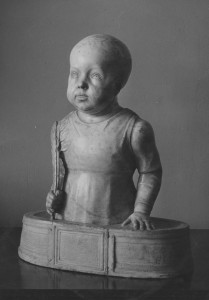
She felt like a detective. Digging through notes and photos, asking for curatorial files, and doing research on child martyrs. She did all of this because as she gazed at the marble bust of a little boy at the J. Paul Getty Museum in Los Angeles something just didn’t fit for Jeanette Kohl, chair of the art history department at the University of California, Riverside.

Turns out, Kohl’s instincts were correct, and the 15th century bust titled “Saint Cyricus” does not depict the child martyr, but rather a different child, Simon of Trent, who disappeared on Easter of 1475 and was soon found dead. Given Kohl’s thorough research, the Getty plans to change the label and identification of the important sculpture by the end of 2016.

Read more…


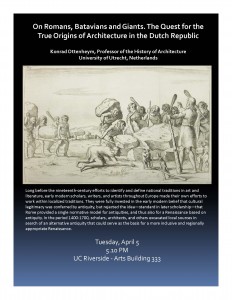
Konrad Ottenheym, University of Utrecht, Netherlands

On Romans, Batavians and Giants. The Quest for the True Origins of Architecture in the Dutch Republic
Konrad Ottenheym, Professor of the History of Architecture

University of Utrecht, Netherlands

In thinking about the creation of ‘national literature’ and ‘national styles’ in art and architecture, most people will refer to the 19th century: the period of the rise of national states and the attempt to codify specific geographically and nationally defined identities in art, architecture and literature, based on models from a glorious past. Nevertheless, five hundred years before this era, humanist scholars, artists, monarchs and other political leaders all over Europe had already charged themselves with a comparable task. In late medieval and early modern Europe, c. 1400–1700,
authority was formally based on lineage, and in all countries political ambitions and geographical claims were supported by true or false historical justifications. Literature, architecture, and paintings were also used to express these ideas of national or local history and that its earliest roots in the distant past.

The strong and conscious interest in national and local history as expressed during this period in the arts has not yet been studied systematically in an interdisciplinary way. In art history, most
attention is still given to the reception of the ‘international’ canon of Greek and Roman antiquities – such as the well-known ruins in Rome and its surroundings – and of ‘classical’ Greek sculpture. And until rather recently, research on Neo-Latin literature was focused on the reception of the classical Greek and Roman authors, while historical works on the ‘medieval’ or local past were neglected. The local or medieval past, however, played a pivotal role. In current mainstream interpretations of ‘Renaissance’ art as a ‘Rebirth of Antiquity,’ antiquity has misleadingly acquired a standard definition based on the international canon. In this perspective, there seems to be only one ideal Antiquity and only one proper embodiment of Antiquity Reborn: the reception of Rome’s antiquities in 15th- and 16th-century Florence and Rome. Thus, the bias toward a ‘proper’ antiquity has generated the idea of a ‘proper’ Renaissance. Consequently, most Antiquity-inspired architecture, art, and literature in Northern Europe – as well as in Spain, France, and the Italian periphery from Lombardy to Sicily – has been analysed and interpreted with Central Italian solutions as a single point of reference, and has often been seen as ‘provincial,’ ‘hybrid,’ or ‘still a little bit medieval.’ As a result, the specific meaning of conscious references to local history also remained obscure. Instead of addressing incorrect or vernacular transformations of the Roman ideal, however, we have to look for a more positive explanation for those examples of the Antique that do not resemble the ‘standard.’ Therefore, we must ask by what means – i.e., through which other models or interpretations of antiquities – artists and patrons created their reconstructions of Antiquity.

In the past few decades the concept of the Rome-centered Renaissance has been seriously challenged. Recent scholarship has stressed the important role assumed by non-Central Italian
antiquities – such as those of Ancient Gaul and in the Low Countries, as well as texts such as Tacitus’s Germania – in the genesis of ‘Antique’ architecture that was not inspired by Central Italy. Moreover, the definition of the ‘Antique’ has turned out to be far more elastic: in fact, it encompasses more than ‘Rome.’ The historical eras used in such constructions could be rather diverse. Sometimes passages or episodes from classical historical writings were quoted and integrated into early modern national or local history, such as the tales of the Trojans who had left their destroyed city to become the founders of various peoples, cities, or noble families all over Europe. In the construction of national histories, local tribes mentioned in classical texts sometimes played a central role as true and antique ancestors, like the Batavians in the northern Low Countries or even elder ancestors, as will be explained in this lecture.

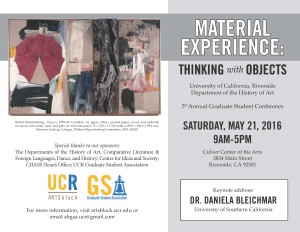
Material Experience: Thinking With Objects
5th Annual UCR History of Art Graduate Student Conference

Culver Center of the Arts
May 21, 2016

New theories in art history, cultural studies, and philosophy have recently called attention to the power of matter in shaping our perception of the world. However, attention to materiality is nothing new. For example, in the 12th century, Abbot Suger defended his extravagant art program at St. Denis in part by inscribing on its doors that “the dull mind rises to the truth through material things.” Suger’s statement makes clear the profound and illuminating potential of material objects that has persisted, in varying forms, throughout history.

However, James Elkins has observed recently that fields of visual studies are characterized by an enduring disparity between written theories about objects and the embodied experience of one’s encounter, indicating more broadly what he calls a “fear of materiality.” At a time in which our experience of art, architecture, and other objects in visual culture is often physically removed through their circulation as digital images, this topic arrives with a detectable urgency. How should we in turn experience the things of the world? This multi-disciplinary conference will address how the material conditions of objects invigorate social, political, and aesthetic spheres.

Questions we seek to consider: What role does materiality have in shaping our perception of objects? How do emerging or established theories of materiality impact art history, visual studies, and other disciplines? And, accordingly, what are the limits of these theories? Do the means of production and exchange alter our perception of the material object? And finally, how does art, regarded as material culture, function as historical evidence?

We are honored to host Dr. Daniela Bleichmar, Associate Professor in the Departments of Art History and History at the University of Southern California, as this year’s keynote speaker.

Call for Papers (Submission deadline: March 1, 2016)

For more information, visit https://artsblock.ucr.edu/Program/Material-Experience