
The Second Annual Wong Forum on Art and the Immigrant Experience
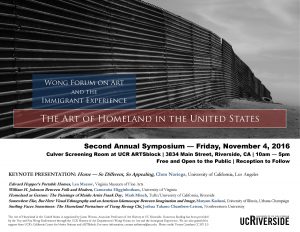 THE ART OF HOMELAND AND THE UNITED STATES
This symposium examines the idea of homeland in the art and visual culture from the region now called the United States. As a concept, homeland plays a vital role in the shaping of individual and collective identity. Most directly, homeland can be understood to signify a person or people’s place of origin. The concept is in this way deeply embedded in the specifics of location and lineage. At the same time, the term also connotes a more subjective and contingent set of allegiances, including those of family, community, nation, religion, race, ethnicity, environment, and experience. Through these bonds, identification with a homeland provides one of the main anchors of individual being, group cohesiveness, and social legitimacy. Forging such connections offers people roots, a framework for binding to others and, ultimately, a sense of place in the world. The notion homeland is, in this way, a positive cultural force.
At the same time, the idea of homeland has been an abiding source of contention, divisiveness, and violence. Human history is pervaded with trauma and injustice enacted over claims to homelands both actual and metaphorical. In this way, the assertion of a homeland has tested the very possibility of social cohesion and self-determination. In the United States especially, where an array of constituencies struggle—often inequitably—to build for themselves a sense of place and belonging, laying claim to a homeland has become synonymous with struggles over voice, power, and beliefs. This can be seen historically in the US histories of colonization, indigenous removal, African American enslavement, and other longstanding pattern of unofficial and state-sanctioned inequality toward minorities. In our recent moment of globalization, the visibility of the concept has grown, from the post-9/11 founding of the Department of Homeland Security to the unsettling strains of anti-immigrant sentiment that mar the current presidential contest.
We will explore how the visual arts provide a powerful means to negotiate the problems and possibilities inherent to the notion homeland. What roles have visual and material expression played in shaping both dominant and alternative visions of the US as homeland? How have these efforts influenced broader discourses of American identity—or failed to do so? How has the question of homeland influenced the form, content, and purpose of the artistic expression? How might studying evocations of homeland in art help us to better understand and historicize the term’s cultural value and impact? Particular attention will be given to the understanding the topic through the prism of dialogue, with the idea that art provides a unique medium for the exchange of ideas across boundaries of identity and experience.
Schedule of Events:
10-10:10 am — Welcome
10:10-10:30 — Framing Remarks, Jason Weems, Associate Professor, University of California, Riverside
10:30-11:00 — Edward Hopper’s Portable Homes, Leo Mazow, Curator of American Art, Virginia Museum of Fine Arts
11:00-11:30 — Kara Walker, Imagining Home, Rebecca Peabody, Head of Research Projects and Programs, Getty Research Institute
11:30-11:50 — Questions
11:50-1:10 — Lunch Break
1:10-1:50 — Keynote Presentation: Home—So Different, So Appealing, Chon Noriega, University of California, Los Angeles
1:50-2:10 — Questions
2:10-2:20 — Short Break
2:20-2:50 — Homeland as Gesture: The Paintings of Maidu Artist Frank Day, Mark Minch, Sawyer Fellow, Tufts University/Assistant Professor, University of California, Riverside
2:50-3:20 — Somewhere Else, But Here: Visual Ethnography and an American Islamoscape Between Imagination and Image, Maryam Kashani, Assistant Professor, University of Illinois, Urbana-Champaign
3:20-3:50 — Smiling Faces Sometimes: The Homeland Portraiture of Tseng Kwong Chi, Joshua Takano Chambers-Letson, Assistant Professor, Northwestern University
3:50-4:10 — Questions
4:10-4:45 — Moderated discussion with all presenters; audience participation encouraged
4:50 — Reception
For more information, contact arthistory@ucr.edu
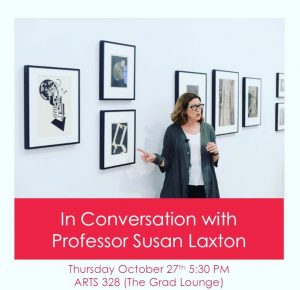 In Conversation with Susan Laxton
 On Thursday, October 6, 6pm-8pm, UCR ARTSblock hosts its Fall Reception. This event is organized in conjunction with the City of Riverside’s First Thursdays ArtsWalk. Come check out the current exhibitions, including Unruly Bodies: Dismantling Larry Clark’s Tulsa; Laurie Brown: Earth Edges; Rotation 2015: Recent Acquisitions; and Steve Rowell: Parallelograms at the California Museum of Photography, as well as Instilled Life: The Art of the Domestic Object at the Sweeney Art Gallery, and For the Record… Contemporary Videos from the Permanent Collection of the Sweeney Art Gallery in the Culver Center atrium.
 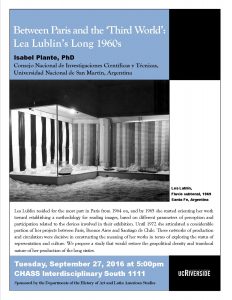 Between Paris and the ‘Third World’: Lea Lublin’s Long 1960s
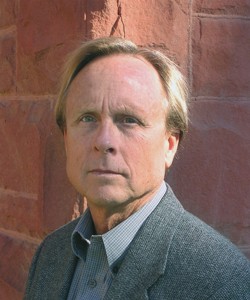 Dr. Rudolph is an art historian whose research focuses on the art of Medieval Europe, with special attention to the role of visual expression in the articulation of intellectual and theological concepts, and their dissemination into the broader culture. As a medievalist, Rudolph’s work is lauded not only for its historical rigor, but also for its conceptual daring and theoretical sophistication. Rudolph is known to be a scholar who fearlessly asks the big questions. He also possesses the rare gift of being able to make complex and historically distant imagery clear and compelling to a twenty-first century audiences.