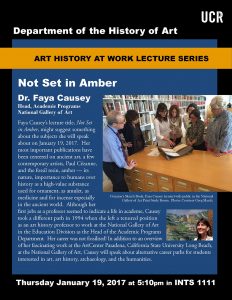
Not Set in Amber

Dr. Faya Causey
Head, Academic Programs
National Gallery of Art

Faya Causey’s lecture title, Not Set in Amber, might suggest something about the subjects she will speak about on January 19, 2017.  Her most important publications have been centered on ancient art, a few contemporary artists, Paul Cézanne, and the fossil resin, amber — its nature, importance to humans over history as a high-value substance used for ornament, as amulet, as medicine and for incense especially in the ancient world.  Although her first jobs as a professor seemed to indicate a life in academe, Causey took a different path in 1994 when she left a tenured position as an art history professor to work at the National Gallery of Art in the Education Division as the Head of the Academic Programs Department.  Her career was not fossilized! In addition to an overview of her fascinating work at the ArtCenter Pasadena, California State University Long Beach, at the National Gallery of Art, Causey will speak about alternative career paths for students interested in art, art history, archaeology, and the humanities.
 

2016 Work in Progress Series
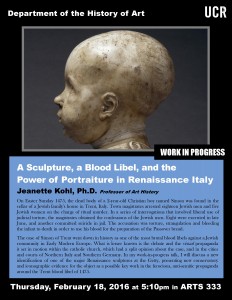
A Sculpture, a Blood Libel, and the Power of Portraiture in Renaissance Italy
Jeanette Kohl, Ph.D. Professor of Art History

On Easter Sunday 1475, the dead body of a 2-year-old Christian boy named Simon was found in the cellar of a Jewish family’s house in Trent, Italy. Town magistrates arrested eighteen Jewish men and five Jewish women on the charge of ritual murder. In a series of interrogations that involved liberal use of judicial torture, the magistrates obtained the confessions of the Jewish men. Eight were executed in late June, and another committed suicide in jail. The accusation was torture, strangulation and bleeding the infant to death in order to use his blood for the preparation of the Passover bread.

The case of Simon of Trent went down in history as one of the most brutal blood libels against a Jewish community in Early Modern Europe. What is lesser known is the debate and the visual propaganda it set in motion within the catholic church, which had a split opinion about the case, and in the cities and courts of Northern Italy and Southern Germany. In my work-in-progress talk, I will discuss a new identification of one of the major Renaissance sculptures at the Getty, presenting new conservatory and iconographic evidence for the object as a possible key work in the ferocious, anti-semitic propaganda around the Trent blood libel of 1475.

The Department of the History of Art Has Unanimously Approved the Following Statement in Response to the Presidential Election of 2016

RESPONSE TO PRESIDENTIAL ELECTION, 2016

The Department of the History of Art is committed to the intellectual inquiry and rigorous analysis of artistic practices from across the globe and across time. It is our belief that a socially and politically responsible art history produces encounters with and the study of diverse cultures, which inspires both tolerance and ethical conduct, reminding us of our shared humanity.  The repeated instances of xenophobic, racist, and misogynist language that characterized the recent presidential election is antithetical to the principles of this department which stands for the inclusion of a plurality of views. This rhetoric and the actions it engenders threaten the core values of our department, our university, and the UC system as a whole. Echoing the words of UC President Janet Napolitano, we “remain absolutely committed to supporting all members of our community and adhering to UC’s Principles Against Intolerance.“ We are concerned that some now face  heightened risk of harassment and as a department we condemn discrimination, marginalization, and violence against any member of our community. We affirm our commitment to the diverse student population of UCR and offer our support and protection to students who feel vulnerable, due to their immigration status, gender or nationality.   The current political climate has only sharpened our convictions about the imperatives of studying histories and diverse visual cultures.  Critical thinking, factual argumentation, and lucid debate are even more vital in a climate of derisive language, images, symbols, and behaviors.  One cannot underestimate the value of understanding history in shaping our collective future.

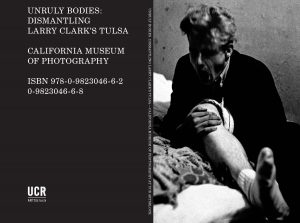
ub_ucr_cover_finalUnruly Bodies: Dismantling Larry Clark’s Tulsa
Riverside: California Museum of Photography, 2016
Susan Laxton, editor

Between 1963 and 1971, the photographer Larry Clark shot and filmed his close group of friends, drug addicts in Tulsa, Oklahoma. When the images were published as the photo book Tulsa (1971), the pictures seared the wholesome image of the American heartland with graphic depictions of sex, drugs, and violence. Clark’s exposé was regarded alternately as a wretched narrative of the decline of American youth, accomplished at the expense of the bodies it represented, and welcomed as an artistic watershed of participant observer-oriented personal documentary valued for the photographer’s privileged access to hidden subcultures. Published in conjunction with the eponymous exhibition at the California Museum of Photography, Unruly Bodies seeks to remix Clark’s original story into a critical exhibition that moves beyond sensationalism toward examining the implications of such a photographic project for contemporary life.


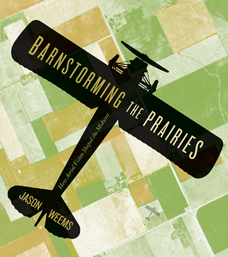
Jason Weems has won the Fred B. Kniffen Book Award for Best Authored Publication, and the John Gjerde Prize for the Best Book on Midwestern History awards for his book, “Barnstorming the Prairies: How Aerial Vision Shaped the Midwest.”

https://ucrtoday.ucr.edu/40719

Barnstorming the PrairiesWriting a book is an all-encompassing commitment,” Weems said. “As scholars, we do it because of a belief that we can bring about a better understanding of the world. When trusted colleagues suggest that you might be succeeding in that effort, it is very special.”
The book offers a panoramic view of the transformative nature and power of aerial vision that remade the Midwest in the wake of the airplane. It addresses how fight led to a new view of the Midwest, and how aerial vision helped to recast the Midwestern landscape amid the technological change and social uncertainty of the early 20th century.

The Fred B. Kniffen Book Award for Best Authored Publication is awarded by the International Society for Landscape, Place and Material Culture Studies (ISLPMC). The ISLPMC encourages and recognizes books by authors regarding North American material culture, which is the physical evidence of culture, such as objects and architecture. Named for the renowned geographer, Fred Kniffen, the prize in his honor is granted annually for the best book in the field published within two years of the award.
WeemsBig
The Jon Gjerde Prize for the Best Book on Midwestern History is awarded by the Midwestern History Association to the best book authored on a Midwestern history topic during a calendar year. In the award announcement, it was noted that “Weems directs our attention to bird’s-eye-view maps, historic atlases, the paintings of Grant Wood, Frank Lloyd Wright plans, Farm Service Administration photos, as well as aerial photographs, to explore both the physical and the imaginative landscape of the Midwest.”


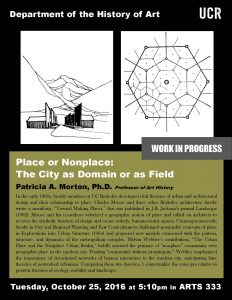
Work In Progress Series – Patricia A. Morton, PhD

Work in Progress Series — Patricia A. Morton, PhD

Place or Nonplace: The City as Domain or as Field

Patricia A. Morton, Ph.D. Professor of Art History

In the early 1960s, faculty members at UC Berkeley developed rival theories of urban and architectural design and their relationship to place. Charles Moore and three other Berkeley architecture faculty wrote a manifesto, “Toward Making Places,” that was published in J.B. Jackson’s journal Landscape (1962). Moore and his co-authors valorized a geographic notion of place and called on architects to recover the symbolic function of design and create orderly, human-centric spaces. Contemporaneously, faculty in City and Regional Planning and East Coast planners challenged geographic concepts of place in Explorations into Urban Structure (1964) and proposed new models concerned with the pattern, structure, and dynamics of the metropolitan complex. Melvin Webber’s contribution, “The Urban Place and the Nonplace Urban Realm,” boldly asserted the primacy of “nonplace” community over geographic place in the modern city. Positing “community without propinquity,” Webber emphasized the importance of deracinated networks of human interaction to the modern city, anticipating later theories of networked urbanism. Comparing these two theories, I contextualize the concepts relative to postwar theories of ecology, mobility and landscape.