Hot off the Presses: “The Human Being in American Art: A Transatlantic Book Launch”
We are pleased to announce an unconventional book launch celebrating the publication of Humans, a book about the history and future of the idea of the human being in American Art and Culture.
Wednesday, April 20 from 9:00-10:30am
 HUMANS
Edited by Laura Bieger (University of Groningen), Joshua Shannon (University of Maryland), and Jason Weems (University of California Riverside)
Volume 5 of Terra Foundation Essays, Terra Foundation/University of Chicago Press, 2022
DESCRIPTION:
Humans are organisms, but “the human being” is a term referring to a complicated, self-contradictory, and historically evolving set of concepts and practices. Humans explores competing versions, constructs, and ideas of the human being that have figured prominently in the arts of the United States. These essays consider a range of artworks from the colonial period to the present, examining how they have reflected, shaped, and modeled ideas of the human in American culture and politics. The book addresses to what extent artworks have conferred more humanity on some human beings than others, how art has shaped ideas about the relationships between humans and other beings and things, and in what ways different artistic constructions of the human being evolved, clashed, and intermingled over the course of American history. Humans both tells the history of a concept foundational to US civilization and proposes new means for its urgently needed rethinking. Authors include Alan Braddock (William & Mary), Jessica Horton (University of Delaware), Michael Leja (University of Pennsylvania), Caroline Arscott (Courtauld Institute of Art), Larne Abse Gogarty (University College London), Jean-Phillipe Antoine (Paris 8 University), and Cherise Smith (University of Texas Austin).
—
Each of the volume’s authors will speak for five minutes in response to the questions below, before the event opens to audience discussion: What concepts of “the human” are needed now? What does it mean–and what does it take–to be human today? What role can art play in fostering the roles and understandings of the human being necessary now? What can we do now (as scholars, as members of society) to shape humanity for the future?
—
Wednesday, April 20 at 9:00 PDT (12:00 EDT, 17:00 BST, 18:00 CEST)
This is a VIRTUAL event
Sponsored by the Center for Ideas and Society, University of California, Riverside
Co-sponsored by the Research Center for the Study of Democratic Cultures and Politics, University of Groningen; and the Potomac Center for the Study of Modernity, University of Maryland
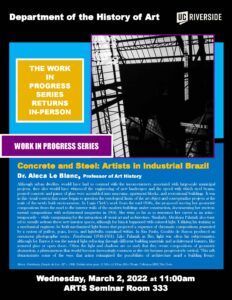 Although urban dwellers would have had to contend with the inconveniences associated with large-scale municipal projects, they also would have witnessed the engineering of new landscapes and the speed with which steel beams, poured concrete and panes of glass were assembled into museums, apartment blocks, and recreational buildings. It was in this visual context that some began to question the ontological limits of the art object and conceptualize projects at the scale of the newly built environments. In Lygia Clark’s work from the mid-1950s, she proposed moving her geometric compositions from the easel to the interior walls of the modern buildings under construction, documenting her environmental compositions with architectural maquettes in 1956. She went so far as to renounce her career as an artist—temporarily — while campaigning for the integration of visual art and architecture. Similarly, Abraham Palatnik also wanted to visually activate these new interior spaces, although for him it happened with colored light. Utilizing his training as a mechanical engineer, he built mechanized light boxes that projected a sequence of chromatic compositions generated by a system of pulleys, gears, levers, and lightbulbs contained within. In São Paulo, Geraldo de Barros produced an enormous photographic series, Fotoformas (1946-1951). Like Palatnik in Rio, light was often his subject-matter, although for Barros it was the natural light refracting through different building materials and architectural features, like textured glass or open doors. Often the light and shadows are so stark that they create compositions of geometric abstraction, a phenomenon that would become increasingly common as the city became progressively vertical. This talk demonstrates some of the ways that artists reimagined the possibilities of architecture amid a building frenzy.
 The Kunsthistorisches Institut in Florenz is a research institute of the Max Planck Society dedicated to the history of art and architecture. Its main areas of focus are the art and visual culture of Italy, Europe and the Mediterranean sphere in the global context. The scientific advisory board is composed of internationally respected academics from Germany and abroad. Its task is to evaluate the Institute’s academic activities on a regular basis.