VISITING SPEAKING SERIES
Replicated Afterlives: Reviving a Ruined Imperial Garden as Theme Park in Post-Mao China
Dr. Patricia J. Yu, Assistant Professor of Art History, Scripps College
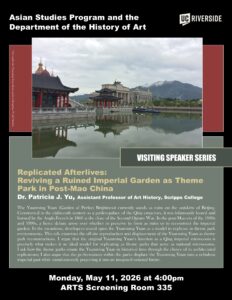 The Yuanming Yuan (Garden of Perfect Brightness) currently stands as ruins on the outskirts of Beijing. Constructed in the eighteenth century as a garden-palace of the Qing emperors, it was infamously looted and burned by the Anglo-French in 1860 at the close of the Second Opium War. In the post-Mao era of the 1980s and 1990s, a fierce debate arose over whether to preserve its form as ruins or to reconstruct the imperial garden. In the meantime, developers seized upon the Yuanming Yuan as a model to replicate in theme park environments. This talk examines the off-site reproduction and displacement of the Yuanming Yuan as theme park reconstructions. I argue that the original Yuanming Yuan’s function as a Qing imperial microcosm is precisely what makes it an ideal model for replicating as theme parks that serve as national microcosms. I ask how the theme parks situate the Yuanming Yuan in historical time through the choice of its architectural replications; I also argue that the performances within the parks displace the Yuanming Yuan into a nebulous imperial past while simultaneously projecting it into an imagined national future.
Monday, May 11 at 4:00pm
Arts Screening Room 335
Sponsored by the Asian Studies Program and the Department of the History of Art
 Emily Citino, 2025 Barbara B. Brink Travel Award
 Demonstrating a loud and clear commitment to advancing its world-class research enterprise, the University of California, Riverside (UCR) announces that Susan Laxton, Associate Professor of Modernism and the History of Photography and Chair of the Department of the History of Art, has been selected for the esteemed
 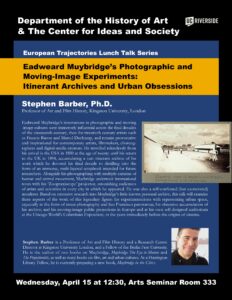 Eadweard Muybridge’s innovations in photographic and moving-image cultures were immensely influential across the final decades of the nineteenth century, then for twentieth century artists such as Francis Bacon and Marcel Duchamp, and remain provocative and inspirational for contemporary artists, filmmakers, choreographers and digital-media creators. He travelled relentlessly from his arrival in the USA in 1850 at the age of twenty until his return to the UK in 1894, accumulating a vast itinerant archive of his work which he devoted his final decade to distilling into the form of an immense, multi-layered scrapbook intended for future researchers. Alongside his photographing with multiple cameras of human and animal movement, Muybridge undertook international tours with his ‘Zoopraxiscope’ projector, astonishing audiences of artists and scientists in every city in which he appeared. He was also a self-confessed (but exonerated) murderer. Based on extensive research into Muybridge’s little-known personal archive, this talk will examine three aspects of the work of this legendary figure: his experimentations with representing urban space, especially in the form of street-photography and San Francisco panoramas; his obsessive accumulation of his archive; and his moving-image public projections in Europe and at his own self-designed auditorium at the Chicago World’s Columbian Exposition, in the years immediately before the origins of cinema.
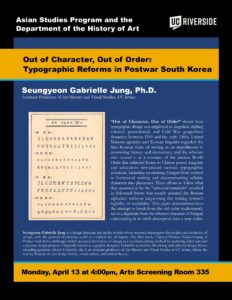 “Out of Character, Out of Order” shows how typographic design was employed to negotiate shifting colonial, postcolonial, and Cold War geopolitical dynamics between 1945 and the early 1960s. United Nations agencies and Korean linguists regarded the Sino-Korean form of writing as an impediment to promoting literacy and democracy; and the scholars also viewed it as a remnant of the ancient World Order that subjected Korea to Chinese power. Linguists and educators introduced various typographic solutions, including reorienting Hangeul from vertical to horizontal writing and deconstructing syllabic characters into phonemes. These efforts to follow what they assumed to be the “universal standards” resulted in deformed letters that merely imitated the Roman alphabet without improving the writing system’s legibility or readability. This paper demonstrates how the attempt to break from the old order inadvertently led to a departure from the inherent character of Hangeul, culminating in its swift absorption into a new order.