Operativity and Digital Capture: A Public Symposium
January 11, 2025 | 10am-3pm
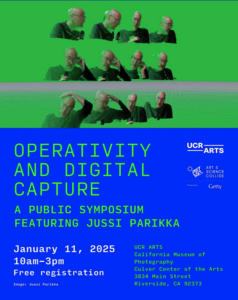
Operativity and Digital Capture PosterOperativity and Digital Capture is a public symposium with media archeologist, Dr. Jussi Parikka, the first Visiting Professor at @ideasandsociety . At this event, theorists, artists, scholars and practitioners from Southern California will discuss the operations of machine vision, especially relating to agency, culpability and connection in an image world functioning at a remove from human engagement.

The symposium is presented as a part of Digital Capture: Southern California and the Pixel-Based Image World on view at UCR ARTS California Museum of Photography and Culver Center of the Arts from September 21, 2024 to February 2, 2025.

Registration is free and seats are limited. https://ucrarts.ucr.edu/…/operativity-and-digital-capture/

UCR ARTS
California Museum of Photography
Culver Center of the Arts
3824 + 3834 Main Street
Riverside, CA 92501
ucrarts.ucr.edu

Digital Capture is made possible with leading support from Getty through the @pstinla : Art & Science Collide initiative.

Co-presented by University of California, Riverside’s California Museum of Photography, Center for Ideas and Society, History of Art Department, and Media and Cultural Studies Department. Additional support provided by the English Department at UCR. Support for the Inaugural CIS Visiting Professor is generously funded by UCR’s Office of the Vice Provost for International Affairs, Marko Princeva.
CHASS Professors Jeanette Kohl and Johannes Endres Close the World Art History Institute’s Distinguished Lecture Series in Shanghai

The lecture series on Renaissance art and culture brought together 12 scholars, featuring workshops and presentations
By Alejandra Prado, Writer/CHASS Marketing and Communications | 


Jeanette Kohl and Johannes Endres in China for the WAI Lecture SeriesUC Riverside’s Jeanette Kohl, associate professor of art history, concluded the 2023-24 World Art History Institute’s (WAI) Distinguished Lecture Series on Renaissance Art and Culture during a September trip to China. As a distinguished visiting professor, Kohl delivered the closing lecture at Shanghai International Studies University (SISU), following a series of presentations and a two-day workshop that explored new perspectives of art history and culture during a two-week visit spanning three cities.
“It was a particular honor to give the closing lecture for a year-long series with such esteemed international scholars,” Kohl said. Kohl, who also serves as co-director for UCR’s Center for Ideas and Society (CIS), was invited by Chinese art historian LaoZhu, the founder of WAI.

This year’s series, “Dialogues with Distinguished Scholars of World Art History,” brought together 12 experts in European Renaissance art from the U.S. and Europe for monthly lectures to foster dialogue between Eastern and Western perspectives on art history. Kohl was also accompanied by her husband and UCR colleague, Johannes Endres, professor of art history and comparative literature, who also delivered a keynote and co-led a workshop with Kohl at the Lu Xun Academy of Fine Arts (LAFA) in Shenyang, China.

Closing the lecture series, Kohl presented her keynote lecture, “A Murder, a Mummy, and a Bust – Forensics of a Renaissance Portrait Sculpture,” at SISU. The lecture highlighted Kohl’s approach to Renaissance art, using the bust of Simon of Trent – an object closely linked to anti-Semitic persecution during the late 15th century – as an example.

“I presented new conservatory and iconographic evidence for the object as a key work in the ferocious, anti-Semitic propaganda around the Trent blood libel of 1475,” she said. “The unusual object is a particularly suited object to talk about the role of visual and conservatory observation, knowledge of historical contexts, and questions of methodology in Renaissance art history.”

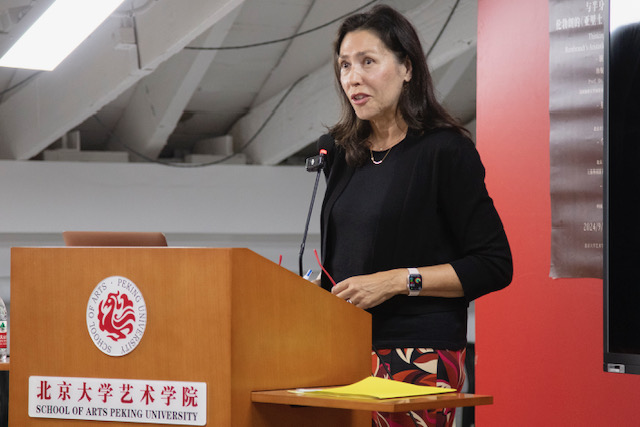
Prior to her lecture at SISU, Kohl also spoke at the School of Arts at Peking University in Beijing, the third-ranked university in China, in a hybrid presentation with both in-person and virtual audiences. Kohl’s lecture, “Thinking with Busts: Rembrandt’s Aristotle with the Bust of Homer,” amassed a virtual attendance of 12,000 viewers on Zoom. 

“This lecture was a unique experience and left a big impression on me,” she said. “Probably the largest audience I will ever reach with a single presentation.”

Kohl’s lecture at Peking University was based on the last chapter of her latest book, “The Life of Bust,” currently in press with Brepols Publishers.

“I spoke about the artistic and ‘phenomenological’ significance of sculpted portraits as a key medium of remembrance that touches humans in unique intellectual and sensory ways,” she said, examining Rembrandt’s famous painting depicting Aristotle as he contemplates a bust of Homer.

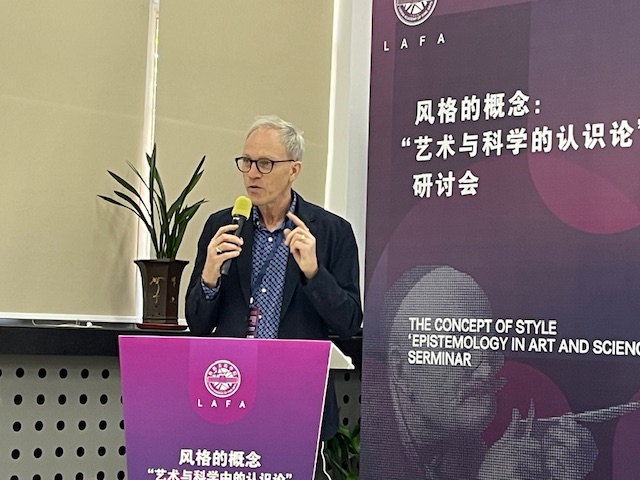
Kohl and Endres engaged with 16 students who presented their papers on Western art traditions in a two-day, “student-centered” workshop at the LAFA. Proposed by Endres, the workshop’s topic, “The Concept of Style: Epistemologies in Art and Science,” is closely related to his research on 19th-century European art and literature.

“The workshop was a great success,” Endres said. “I was thrilled to see how interested our hosts and their students were in our research, and especially in the Western disciplinary methodologies of our common field of art history.”

“I was positively surprised by the students’ open-mindedness, excellent preparation of their papers, their dedication to their topics, and the huge interest in European academic traditions – quite different from the U.S.,” Kohl said. “There was a completely open intellectual exchange, both with colleagues and students, about what is going well and what is going not so well on U.S. campuses and in China.”

For Kohl and Endres, the workshop was eye-opening in the differences between academia in the U.S. and China, even down to student approaches to resources used for study. Both were impressed by the students’ dedication to understanding foreign texts and their proficiency in various languages. 

“Interest in primary textual and visual sources is strong, and we were absolutely taken with the tremendous generosity and hospitality in all three locations, but especially in Shenyang,” Kohl said.

“Their enthusiasm for learning from us was contagious and amazed my wife and me wherever we went on our trip and whatever we did and saw,” Endres said. “In return, they brought us into their country and their academic lives and took us on exciting excursions into the great history of their art and culture.”

At the LAFA workshop, Endres was also invited to speak in a keynote address on “Style in an Interdisciplinary Perspective,” aimed at exploring the evolution of style as a concept across art, science, and other fields. Endres, who has researched the concept of “style” at length, has traced how style has grown from a term used in art and literary criticism about the cultural shaping of work to a broader intellectual framework on discourse in reasoning in different disciplines. 

“In my talk, I was therefore interested in exploring new ways of looking at the relationships between cultural and scientific knowledge formations and their disciplinary production in different fields and objects, such as works of art, literary texts, music, and scientific epistemologies,” he said. 

Speaking and co-leading the workshop at LAFA left Endres with new perspectives and questions for his research. “I learned a great deal from their questions and presentations and from their different cultural backgrounds, as they shared a common interest in questions of style and form in art,” he said.

“There is much to be gained, not least on the academic level, from meeting each other at eye level and cultivating an interest in our respective histories and values,” he said. 

For Endres and Kohl, it was also an opportunity to represent UCR, as both members of the University of California and scholars of European art and culture. 

“Visits and conversations like these are invaluable,” Kohl said. “We need to leave our own academic and national bubbles and actually talk to colleagues in other cultures, connect with their traditions, respect them, and bring an open mind to learn from them and their histories.”

According to Kohl, their two weeks in China were not merely an academic visit but a full cultural immersion. Outside of lectures and presentations, the visit offered Kohl and Endres opportunities to explore local cuisine, museums, and historic sites with tour guides by their side.

“It is such a modern and forward-pushing society, in many ways, and the state of digitization, the cutting-edge technology, and the pride of their own long cultural traditions was palpable everywhere,” Kohl said.

Following their trip, Kohl is motivated to continue working with her colleagues in China by collaborating with them on her new project, “Global Faces,” which examines the various styles of portraiture across cultures during the Renaissance period.

Kohl and Endres hope their visit will strengthen much-needed international academic ties for students and colleagues.

Read more…

Department of the History of Art & The Art History Graduate Student Association

Live from the Library of Congress! A Guide to Visual Archival Research

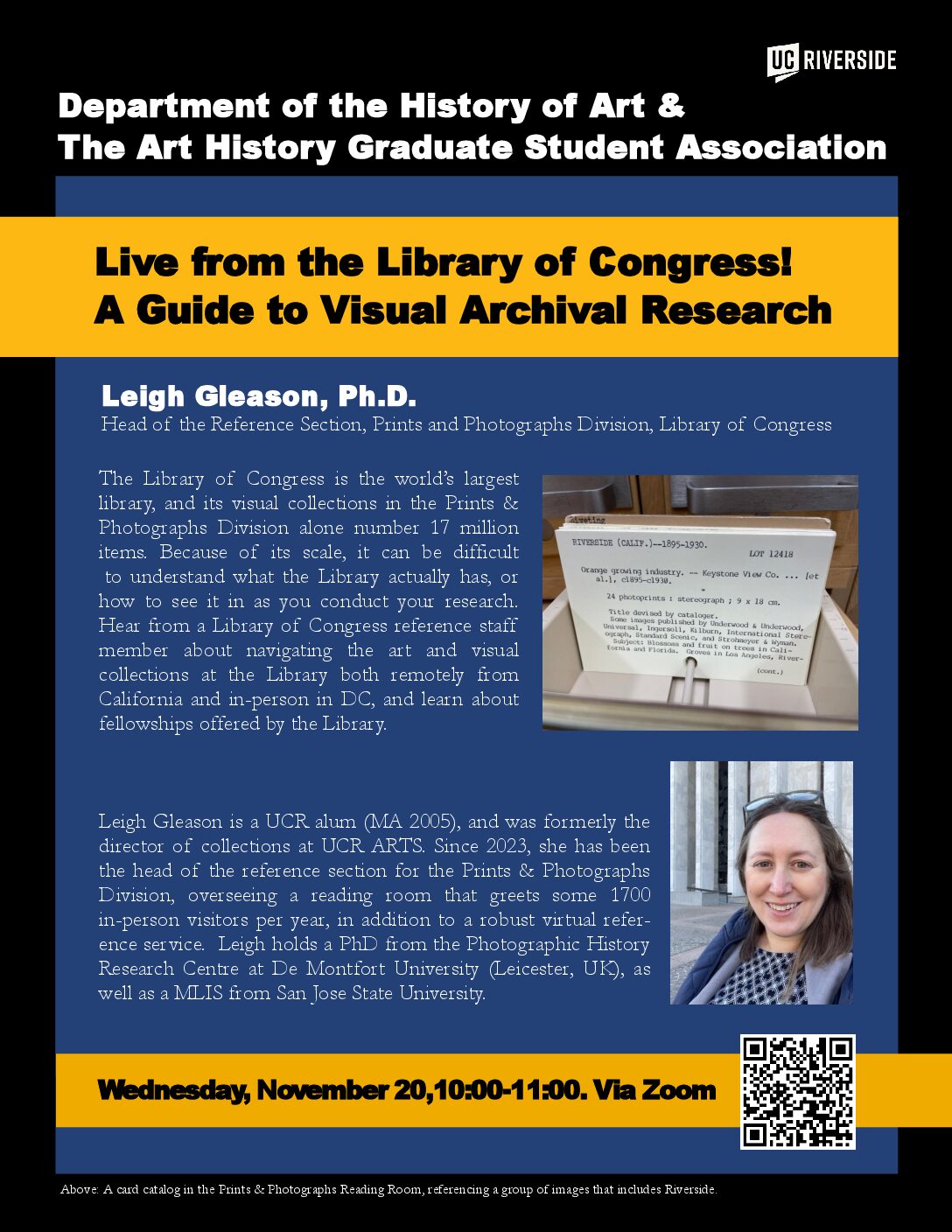
Leigh Gleason, Ph.D.
Head of the Reference Section
Prints and Photographs Division
Library of Congress

The Library of Congress is the world’s largest library, and its visual collections in the Prints & Photographs Division alone number 17 million items. Because of its scale, it can be difficult to understand what the Library actually has, or how to see it in as you conduct your research. Hear from a Library of Congress reference staff member about navigating the art and visual collections at the Library both remotely from California and in-person in DC, and learn about fellowships offered by the Library.j

Leigh Gleason is a UCR alum (MA 2005), and was formerly the director of collections at UCR ARTS. Since 2023, she has been the head of the reference section for the Prints & Photographs Division, overseeing a reading room that greets some 1700 in-person visitors per year, in addition to a robust virtual refer-ence service. Leigh holds a PhD from the Photographic History Research Centre at De Montfort University (Leicester, UK), as well as a MLIS from San Jose State University.

Wednesday, November 20,10:00-11:00. Via Zoom
Join here

Close to the WAI Distinguish Lecture Series

Distinguished Lecturer, Workshop Facilitator and Keynote Speaker, Dr. Johannes Endres and Dr. Jeanette Kohl in Shanghai

To round off the Summer, the History of Art Departments Dr. Jeanette Kohl and Dr. Johannes Endres were distinguished lecturer, workshop facilitator and keynote speaker for the World Art History Institutes (WAI) 12th Distinguished Lecture Series.

As Distinguished Lecturer, Dr. Jeanette Kohl delivered: A Murder, a Mummy, and a Bust – Forensics of a Renaissance Portrait Sculpture at the Liu Haisu Art Museum in Shanghai. Dr. Kohl also provided an additional public lecture at the School of Arts, Peking University on Thinking with Busts. Rembrandt’s Aristotle with the Bust of Homer.

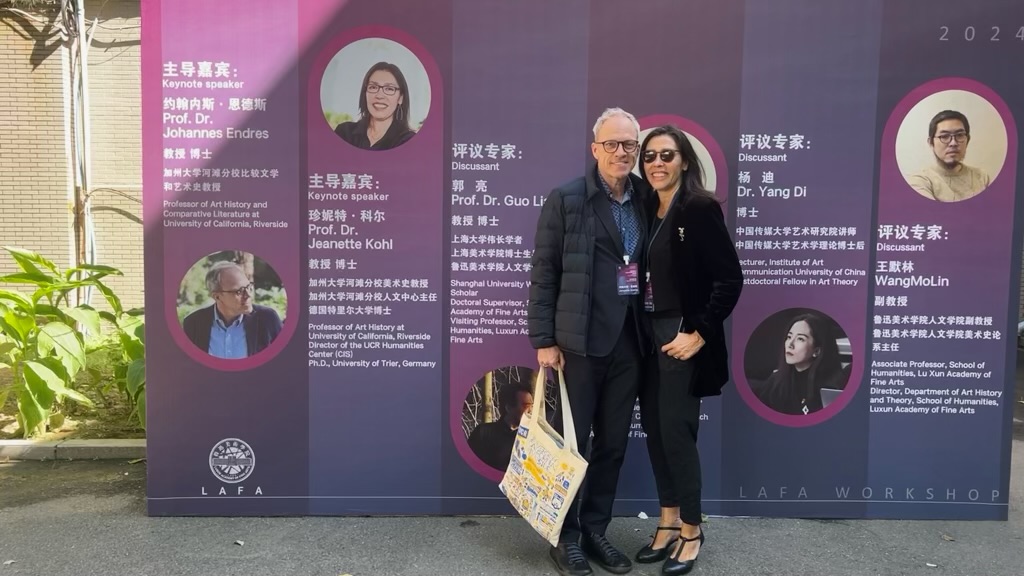
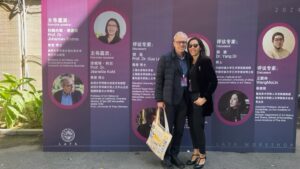
Dr. Endres and Dr. Kohl pose for photo in front of event poster.

Dr. Johannes Endres provided the keynote at the Lu Xun Academy of Fine Arts (LAFA), Shenyang on Style in an Interdisciplinary Perspective.

In addition, Dr. Jeanette Kohl in collaboration with Dr. Johannes Endres lead a two-day workshop on The Concept of Style: Epistemologies in the Arts and Sciences at LAFA.

Here are some words shared by Dr. Jeanette Kohl:

“What an honor to give the final evening lecture at Shanghai‘s new World Art History Institute WAI. They shouldered a year-long program of 12 speakers from the US, the UK, Germany, and Italy holding workshops with Chinese students and giving several talks per visit and in various locations across the country. Last night was the closing ceremony, and I was really moved that they chose me to be present for this. Johannes and I met extremely dedicated colleagues, some brilliant students, and a deep appreciation for European art and culture. Frankly, I wish I‘d see more of this in the US.”


Twelfth Distinguished WAI Lecture on Renaissance Art and Culture

A Murder, a Mummy, and a Bust – Forensics of a Renaissance Portrait Sculpture

Professor Jeanette Kohl, University of California, Riverside

Tuesday, 24 September, 7.30–9.30 pm, UTC+8 Beijing, Shanghai, and Hong Kong, onsiteZoom & Livestreaming [London 12.30–2.30 pm; Berlin 1.30–3.30 pm; New York/Washington D.C. 7.30–9.30 am] LHS Art Museum, Shanghai

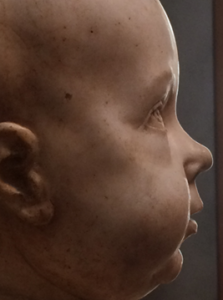
Francesco Laurana (1430–1502), Saint Cyricus (detail), marble, 38.7 diameter, 1470 – 1480. Los Angeles: J. Paul Museum. 

On Easter Sunday 1475, the dead body of a 2-year-old Christian boy named Simon was found in the cellar of a Jewish family’s house in Trent, Italy. Town magistrates arrested eighteen Jewish men and five women on the charge of ritual murder. In a series of interrogations that involved the use of torture, the magistrates obtained the confessions they needed. Eight were executed, others committed suicide in jail. The accusation was torture, strangulation and bleeding the infant to death to use his blood for the preparation of the Passover bread. The case of Simon of Trent went down in history as one of the most brutal and consequential blood libels against a Jewish community in Early Modern Europe. Lesser known is the heated debate about the visual and written propaganda the event set in motion in the cities of Northern Italy and Southern Germany. In my lecture, I will present a new identification of one of the major Renaissance sculptures in the J. Paul Getty Museum, the bust of a child erroneously identified as Saint Cyricus. I will discuss new conservatory and iconographic evidence for the object as a key work in the ferocious, anti-Semitic propaganda around the Trent blood libel of 1475. I will also reinterpret the bust’s role as a devotional image and its relation to the cult of relics that soon emerged around the dead body of Simon of Trent. The unusual object in the Getty collections is a particularly suited object to talk about the role of visual and conservatory observation, knowledge of historical contexts, and questions of methodology in Renaissance art history.

Speaker’s short bio:  Dr. Jeanette Kohl is Professor of Art History at the University of California, Riverside. Since 2021, she also serves as director of the UCR Humanities Center (CIS). Her research in art history focuses on portraiture, sculpture, and concepts of artistic representation and memory in the Italian Renaissance. She earned her PhD from the University of Trier/Germany in 2001 with a dissertation on Bartolomeo Colleoni’s burial chapel in Bergamo/Italy (“Fama und Virtus,” Berlin 2004), which was awarded the university’s prize for outstanding dissertations. Kohl has received fellowships from the Getty Research Institute, the NEH, the Morphomata Center for Advanced Studies at the University of Köln, the Hamburg Institute for Advanced Study (HIAS), and the Institute for Advanced Study (IAS) in Princeton. Her new book “The Life of Busts. Fifteenth-Century Portrait Sculpture in Italy” is in press with Brepols for 2025.

Registration

If you are residing outside mainland China and interested in attending this or other WAI lectures, please register for virtual participation: https://forms.gle/LAj5SkGCuy7Pgu1x9

Tenth Distinguished WAI Lecture on Renaissance Art and Culture

Titian’s Touch

Prof. Dr. Maria Loh, Institute for Advanced Study, Princeton

Thursday, 5 September, 7.30–9.30 pm, UTC+8 Beijing, Shanghai, and Hong Kong, onsite & Zoom
[London 12.30–2.30 pm; Berlin 1.30–3.30 pm; New York/Washington D.C. 7.30–9.30 am]

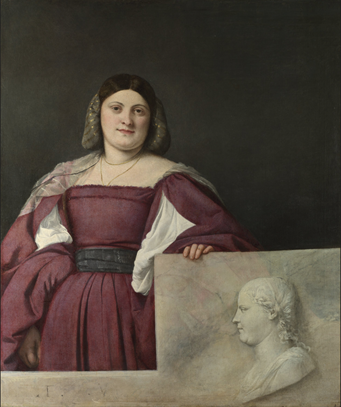
Portrait of a Lady by Titian.

Titian (1490–1576), Portrait of a Lady (“La Schiavona”), ca. 1510–1512, oil on canvas, 119.4 x 96.5 cm. London: National Gallery.

Any given museum or collection will inevitably have a series of paintings that have been categorized simply as Portrait of a Lady for lack of a better title. In the National Gallery in London, there is an extraordinary painting by Titian (Tiziano Vecellio, 1488/90-1576) that has been known for many centuries as both Portrait of a Lady and also La Schiavona, meaning the portrait of the “Dalmatian Lady.” These two titles, I argue, are at once too generic or too specific and neither does justice to the brilliance of the portrait executed by the Venetian Renaissance artist at the start of his long and illustrious career. What more might be said about this portrait, in particular, and about portraiture, more broadly? In the hierarchy of genres, portraiture has long been ranked at the bottom along with still life painting because they are thought to be imitative arts. But a portrait often seeks to achieve so much more than merely recording the surface likeness of a person for posterity. This first lecture in Shanghai will consider these questions in relation to the London painting of the unknown “lady” as well as a second portrait of a disgraced cleric, painted twice by Titian. The aim of this presentation will be to demonstrate the existential nature and philosophical work that portraits undertake.

Speaker’s short bio: Maria Hsiuya Loh is Professor of Art History at the Institute for Advanced Study, Princeton. Loh is the author of Titian Remade: Repetition and the Transformation of Early Modern Italian Art, Still Lives: Death, Desire, and the Portrait of the Old Master, and Titian’s Touch: Art, Magic & Philosophy. Her scholarship has developed radical new approaches to key issues in the field of art history, producing groundbreaking work on originality and repetition, and the emergence of the early modern artist. Loh has also written on rainbow imagery in Stuart England, melancholia and the Renaissance in nineteenth-century Italy, remakes in Chinese cinema, repetition in Alfred Hitchcock’s Vertigo, and the work of contemporary artists such as Sherrie Levine and Jeff Wall.

Registration

If you are residing outside mainland China and interested in attending this or other WAI lectures, please register for virtual participation: https://forms.gle/LAj5SkGCuy7Pgu1x9

Kindly note that Professor Loh’s WAI lecture was initially planned for 23 August 2024, but it has been rescheduled to 5 September 2024. If you are interested in joining this event via Zoom, please mark box number 10.  Those who have registered will receive timely email notifications with the Zoom links prior to each scheduled event.