It is our great pleasure to share that PhD candidate, Molly Bond, will present on her research at the Kunsthistorisches Institut in Florenz.
Wednesday, October 19, 2022 at 5:30 am PDT (2:30 pm GMT+2)
In person at the Palazzo Grifoni (Florence) and online
https://zoom.us/j/95475374245?pwd=c0w4UWt6bk5DM1Y1MkMxSEhBWlQxZz09
Meeting-ID: 954 7537 4245
Spaces of Relief Sculpture: Embodied Spectatorship and the Late Cinquecento “Recanati School”
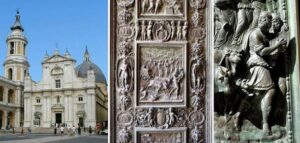 In 1564 Florentine monk and intellectual Vincenzo Borghini deemed basso rilievo the ‘dolce amaro’ of the arts: ‘sweet’ because sculptors might approach the capacity of painting to depict elements of an istoria, but also ‘bitter’ because relief could neither render a convincing painterly illusion of depth nor offer the multiple views of sculpture in the round. Borghini’s opinion of relief as a kind of ‘imperfect hybrid’ (Ostrow 2004, 336) is far from unique: indeed, such ambivalence typifies most writings on relief—themselves very few and far between—from the early modern period. Yet, as uneasy as art theoreticians were with this art form, relief permeated the built environment and daily lives of contemporary Italians, as it invested objects ranging from monumental architectural façades to miniature plaquettes. A partial and ‘imperfect’ amalgamation of painting and sculpture perhaps, but such in-betweenness allowed reliefs to use the means of both in order to engage viewers across an incredibly broad array of socio-spatial contexts. Foregrounding the idea of embodied spectatorship, my presentation will examine both textual accounts and artifacts that respond to particular aspects of such interaction, including that of a spectator’s mobility, tactile engagement, and the changeable environments that conditioned their encounters with relief sculpture. While similar, phenomenologically-oriented approaches have been fruitfully applied to the study of Renaissance sculpture in the round and even painting, these concerns remain underexplored with respect to relief sculpture. Here the production of the late 16th-century ‘Recanati School’ of bronze casters will form my primary case study: not only did these artists develop an unusually strong tradition of bronze relief, but their work spanned a wide variety of different socio-religious spaces—from doors, to chapel walls, to statue bases—in and around the Basilica della Santa Casa di Loreto.
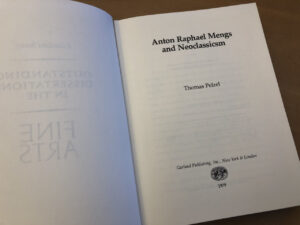 Thomas Pelzel, a professor of Art History during the early years of the university, died on July 3, 2022. Born in West Virginia in 1927, he completed his PhD at Princeton University in 1968 before coming to UCR. Tom served for many years – by special demand and vocal entreaties by colleagues and students – as Undergraduate Advisor but also for a period as Chair. His dissertation on the German painter Anton Raphael Mengs and Neo-Classicism became a book, and he published several important articles on the subject as well. The study of European art and theory of the neoclassical period remained his main field of scholarly work.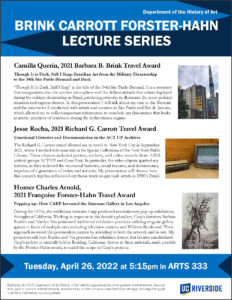
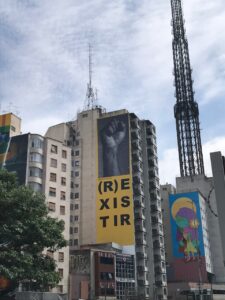
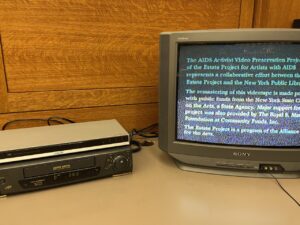 Jesse Rocha, 2021 Richard G. Carrott Travel Award
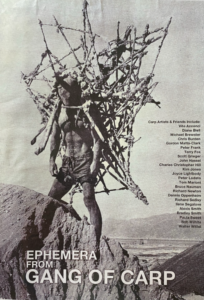 Homer Charles Arnold, 2021 Françoise Forster-Hahn Travel Award
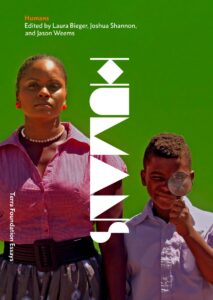 HUMANS
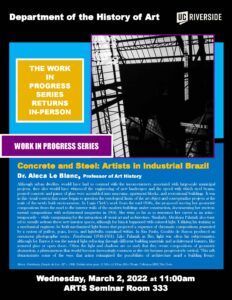 Although urban dwellers would have had to contend with the inconveniences associated with large-scale municipal projects, they also would have witnessed the engineering of new landscapes and the speed with which steel beams, poured concrete and panes of glass were assembled into museums, apartment blocks, and recreational buildings. It was in this visual context that some began to question the ontological limits of the art object and conceptualize projects at the scale of the newly built environments. In Lygia Clark’s work from the mid-1950s, she proposed moving her geometric compositions from the easel to the interior walls of the modern buildings under construction, documenting her environmental compositions with architectural maquettes in 1956. She went so far as to renounce her career as an artist—temporarily — while campaigning for the integration of visual art and architecture. Similarly, Abraham Palatnik also wanted to visually activate these new interior spaces, although for him it happened with colored light. Utilizing his training as a mechanical engineer, he built mechanized light boxes that projected a sequence of chromatic compositions generated by a system of pulleys, gears, levers, and lightbulbs contained within. In São Paulo, Geraldo de Barros produced an enormous photographic series, Fotoformas (1946-1951). Like Palatnik in Rio, light was often his subject-matter, although for Barros it was the natural light refracting through different building materials and architectural features, like textured glass or open doors. Often the light and shadows are so stark that they create compositions of geometric abstraction, a phenomenon that would become increasingly common as the city became progressively vertical. This talk demonstrates some of the ways that artists reimagined the possibilities of architecture amid a building frenzy.