Conrad Rudolph, professor of medieval art history at UCR, was named a Fellow of The Medieval Academy of America.

In medieval studies (history, literature, philosophy, religious studies, art history, etc.) this is the highest honor that can be bestowed upon a medievalist in the United States. Founded in 1925, The Medieval Academy of America is the largest organization in the U.S. promoting excellence in the field of medieval studies.

Rudolph has recently completed a book-length study (and digital reconstruction, http://mysticark.ucr.edu) of Hugh of Saint Victor’s Mystic Ark (c. 1125-1130), a forty-two page description of the most complex individual work of figural art of the Middle Ages, a painting also known as The Mystic Ark. The purpose of the painting was to serve as the basis of a series of brilliant lectures undertaken by Hugh at Saint Victor, a Parisian abbey of Augustinian canons. The purpose of the text was to enable others outside of Saint Victor–teachers, students, scholars, monks, canons–to undertake similar weeks-long discussions themselves by providing the information necessary to produce the image, something that was repeated again and again over the centuries. Depicting all time, all space, all matter, all human history, and all spiritual striving, this highly polemical image deals with a series of cultural issues crucial in the education of society’s elite during one of the great periods of intellectual change in Western history.
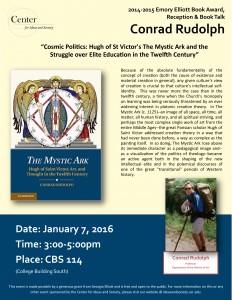
2014-2015 Emory Elliott Book Award, Reception & Book Talk

Conrad Rudolph
“Cosmic Politics: Hugh of St Victor’s The Mystic Ark and the Struggle over Elite Education in the Twelfth Century”

Because of the absolute fundamentality of the concept of creation (both the cause of existence and material creation in general), any given culture’s view of creation is crucial to that culture’s intellectual self-identity. This was never more the case than in the twelfth century, a time when the Church’s monopoly on learning was being seriously threatened by an ever widening interest in platonic creation theory. In The Mystic Ark (c. 1125)–an image of all space, all time, all matter, all human history, and all spiritual striving, and perhaps the most complex single work of art from the entire Middle Ages–the great Parisian scholar Hugh of Saint Victor addressed creation theory in a way that had never been done before, a way as complex as the painting itself. In so doing, The Mystic Ark rose above its immediate character as a pedagogical image and–as a visualization of the politics of theology–became an active agent both in the shaping of the new intellectual elite and in the polemical discourses of one of the great “transitional” periods of Western history.

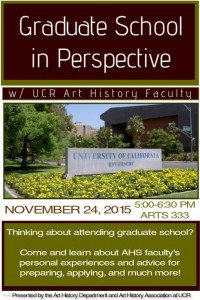
Graduate School in Perspective

Are you planning to attend graduate school or want to learn more about it?
Art History faculty will speak to students about the preparation and application process, and share their own experiences! This will be held on Tuesday, November 24 in ARTS 333 from 5:00-6:30 PM. Please contact the Art History Association at arthistoryucr@gmail.com for any questions regarding the event.

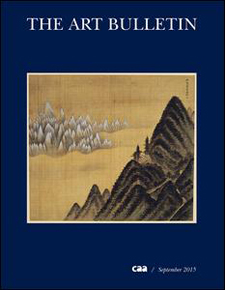
Congratulations to JP Park on his article “The Anxiety of Influence: (Mis)reading Chinese Art in Late Choson Korea (1700-1850)” in the ab_sep2015Art Bulletin.

Woodblock printed painting albums and manuals from early modern China sparked changes in the way some forms of art were produced in late Chosŏn Korea (1700–1800). Although such art books were firmly rooted in the middle-class public in China, most pictorial and literary evidence tells us that these same books were used exclusively by highly positioned artists and critics in early modern Korea. This disparity of readership points to inequalities in cultural exchange and communication between early modern China and Korea, in which misinformation gave rise to a new source of artistic inspiration.


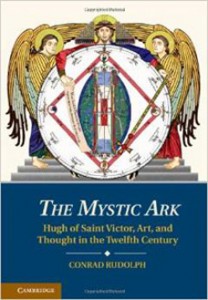
The Mystic Ark- Hugh of Saint Victor, Art, and Thought in the Twelfth Century PreviewConrad Rudolph’s recent book, The Mystic Ark: Hugh of Saint Victor, Art, and Thought in the Twelfth Century (Cambridge University Press, Cambridge and New York, 2014), has won the 2014-2015 Emory Elliott Book Award from the UCR Center for Ideas and Society.
In medieval written sources, works of art are not often referred to, let alone described in any detail. When they are mentioned, it is seldom with more than a word or phrase, at the most a sentence. Almost completely ignored by art historians because of the immense difficulty of its text, Hugh of Saint Victor’s Mystic Ark (c.1125-1130) is a forty-two page description of the most complex individual work of figural art of the Middle Ages, a painting also known as The Mystic Ark. Depicting all time, all space, all matter, all human history, and all spiritual striving, this highly polemical image deals with a series of cultural issues crucial in the education of society’s elite during one of the great periods of intellectual change in Western history. Meant to be copied by others, it is among the most unusual sources we have for an understanding of medieval artistic culture.

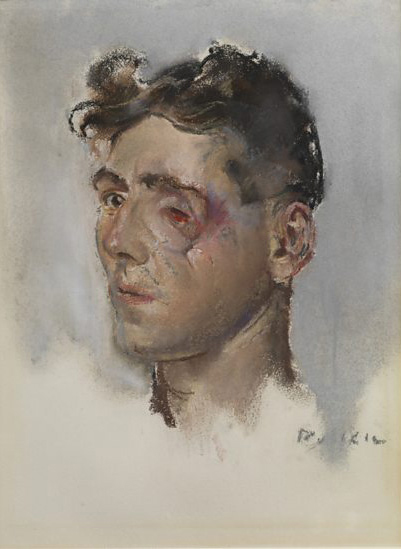
soldier_facial_woundArt History and Medical Education

Small Moments of Change: Medical Humanitieses
An interview conducted with Art History Chair Jeanette Kohl by Katherine Miller

With the introduction of consistent and effective medical practices in the 1900s patients lived longer, healthier lives. But with the onset of WWI, medical staff encountered a new challenge: patients who survived the trauma of face mutilation but were unable to look at themselves in a mirror. Doctor and academy trained artist Henry Tonks found a solution in using watercolors to paint new representations of his patients. Through his art he was able to create beautiful, touching renditions of their disfigurements, and his patients were able to look at themselves for the first time.

Dr. Jeanette Kohl uses this historic example to show how the humanities can foster human connection. Professor Kohl—Chair of the Art History Department at UCR, and passionate art historian with an interest in the history of the body as well as Renaissance portraiture and sculpture—supports creating more inclusive programs linking the humanities and sciences. Last December she organized “Vesalius and His Worlds: Medical Illustrations during the Renaissances” at The Huntington. She explains how this conference brought together people who were interested in the subject from a collecting point of view, a visual point of view, and an academic point of view. Read More