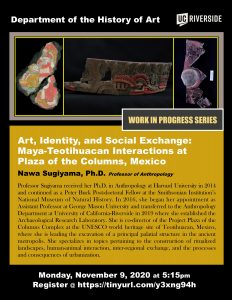
Art, Identity, and Social Exchange: Maya-Teotihuacan Interactions at Plaza of the Columns, Mexico
Join us on Monday, November 9, 2020 at 5:30 pm (PST) — via Zoom
Register @ https://tinyurl.com/y3xng94h
 Nawa Sugiyama, Ph.D.
Department of Anthropology, University of California, Riverside
Professor Sugiyama received her Ph.D. in Anthropology at Harvard University in 2014 and continued as a Peter Buck Post-doctoral Fellow at the Smithsonian Institution’s National Museum of Natural History. In 2016, she began her appointment as Assistant Professor at George Mason University and transferred to the Anthropology Department at University of California-Riverside in 2019 where she established the Archaeological Research Laboratory. She is co-director of the Project Plaza of the Columns Complex at the UNESCO world heritage site of Teotihuacan, Mexico, where she is leading the excavation of a principal palatial structure in the ancient metropolis. She specializes in topics pertaining to the construction of ritualized landscapes, human-animal interaction, inter-regional exchange, and the processes and consequences of urbanization.
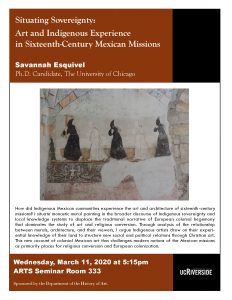 How did Indigenous Mexican communities experience the art and architecture of sixteenth-century missions? I situate monastic mural painting in the broader discourse of Indigenous sovereignty and local knowledge systems to displace the traditional narrative of European colonial hegemony that dominates the study of art and religious conversion. Through analysis of the relationship between murals, architecture, and their viewers, I argue Indigenous artists drew on their experiential knowledge of their land to structure new social and political relations through Christian art. This new account of colonial Mexican art thus challenges modern notions of the Mexican missions as primarily places for religious conversion and European colonization.