
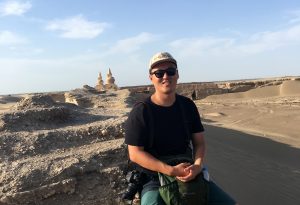
Associate Professor, Undergraduate advisor
Ph.D., Yale University
(951) 827-4634
yong.cho@ucr.edu
As a specialist in the art and architecture of East and Central Asia from medieval and early modern periods, Yong Cho focuses on the question of how artistic creativity emerges when people, objects, and ideas move or become displaced from their place of origin. His research interests cover a broad range of topics: theories of cross-cultural contact, multiculturalism and multilingualism in visual arts, the visual and material cultures of mobile societies, sacred objects and their relationship to ritual, the relationship between making and meaning, and the historiography of Silk Road art and archaeology.
He is the author of The Woven Image: The Making of Mongol Art in the Yuan Empire (Yale University Press, 2026), which investigates a moment of major cultural transformation across Eurasia, when the Mongols, the tent-dwelling pastoral nomadic peoples of the North Asian steppe, became rulers of a world empire. By focusing on woven images, it traces how the Mongol visual culture had a lasting impact in the history of art in East Asia. This book project received research support from the Getty Research Institute, where he was in residence as a postdoctoral scholar during the 2021–22 academic year, and subvention support from the College Art Association Millard Meiss Publication Fund, the Chiang Ching-kuo Foundation Publication Subsidy, the Geiss Hsu Foundation Subvention Award, and International Center of Medieval Art-Kress Publication Grant.
Building upon his interests in the trans-Eurasian visual culture of the Mongol Empire, his current project investigates how the Mongol presence on the Korean peninsula during the last century of the Koryŏ (918–1392) led to the rise of new visual and material forms in Northeast Asia and beyond. This research has received grant support from the Hellman Fellows Fund, the Center for Ideas and Society (UCR), and the University of California Humanities Research Institute.
Education
Areas of Specialization and Research/Teaching Interests:
Interconnectedness of art and architecture in Eurasia from the 4th-14th centuries; Mongol Empire; theories and histories of cross-cultural contact; Buddhist art and architecture; nomadic art and architecture; textile history; material culture theories; animal studies; visual and material culture of shaman rituals in Korea, North Asia, and Siberia; cultural history of Korean diaspora in the former Soviet Union, Japan, China, and the Americas
The Woven Image: The Making of Mongol Art in the Yuan Empire. Yale University Press, 2026.
“What Can the Patterns of Renovation Reveal? Afterlife of the Tibetan Empire in the Tangut Intervention at Dunhuang.” Journal of Asian Studies 84, no. 1 (2025): 139-167.
“The Grid and the Buddha Body: Measurement, Cloth, and Embodiment.” Artibus Asiae 84, no.1 (2024): 5-40.
“La taxonomie des arts à la cour des Yuan.” Translation by Divina Cabo. In Les Mongols et le monde: L’autre visage de l’empire de Gengis Khan, ed. Marie Favereau (Nantes: Musée d’histoire de Nantes, 2023), 218-19.
“Vajrabhairava Mandala.” In Himalayan Art in 108 Objects, eds. Karl Debreczeny and Elena Pakhoutova (New York: Rubin Museum of Art, 2023), 208-11.
https://projecthimalayanart.rubinmuseum.org/essays/vajrabhairava-mandala/
“Juyong Gate: Wall Hangings in Stone.” Archives of Asian Art 73, no.2 (2022): 221-53.
“Silk Road.” In The Encyclopedia of Ancient History: Asia and Africa, eds. D. Potts, E. Harkness, J. Neelis, and R. McIntosh (Malden, MA: Wiley-Blackwell, 2021).
https://doi.org/10.1002/9781119399919.eahaa00706.
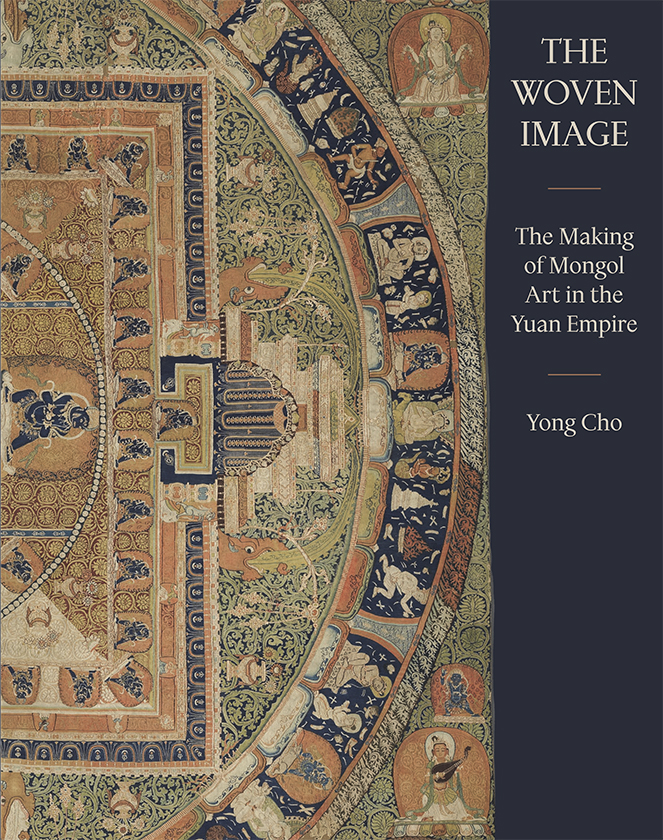 The Woven Image: The Making of Mongol Art in the Yuan Empire
2026, YALE UNIVERSITY PRESS
East Asia’s Yuan Empire (1271–1368), led by the nomadic Mongol people and Qubilai Khan (1215–1294), was marked by cross-cultural exchange and significant developments in trade, technology, and infrastructure. The Mongol visual culture, however, has often been ignored or dismissed as insignificant in the operations of the Mongols’ own empire. The Woven Image: The Making of Mongol Art in the Yuan Empire highlights Yuan tapestries and fabric images to demonstrate Mongol visual culture’s impact on the history of Chinese and East Asian art.
Yong Cho gives medieval Mongols historical agency in constructing new forms of cultural expression and visual knowledge, correcting the misperception that members of the Mongol court primarily played a passive role in the realm of the arts. Cho argues that Mongol rulers oversaw radical experimentations with the artform, facilitating trans-Eurasian movement and interactions of artists and techniques, which led to woven tapestries becoming unprecedented objects of political and sacral power. Using the Vajrabhairava mandala—the best-preserved example of woven image produced during the Yuan—as an anchor, the book examines the Mongol court’s weaving as a reflection of the court itself, including the changing hierarchy of art within the court, politics of patronage, ritual function, and the construction of textiles.